Reflecting on yesterday's post, which had a quote that was admittedly out of context, I started thinking about how Mankiw treats neoclassical theory vis-a-vis other economic theories.
Of course we know that Mankiw intends to present the consensus view of the mainstream of the economics profession, which is (apparently) why he pretends not to be making any conscious decisions about what to include in his book. Rather, he can say that he doesn't mention radical economics because the mainstream no longer engages with radical economics.
But, my point yesterday is partly that we are taking this intention of presenting the consensus for granted. Samuelson, as it may or may not be evident from reading yesterday's quote, felt as though he needed to address Marx and Marxism on their own terms. He actively engaged with "the old man", pointing out what he thought were both the strengths and weaknesses of his ideas. And as one of my professors at UMass Econ (who is an MIT PhD) would tell us in class, Samuelson was always bringing up Marx in his graduate classes! You would walk in the room, hear this guy talking about Marx, and wonder where the hell you were. One certainly does not find that kind of active engagement with radical economics in graduate courses at the top schools today.
But, there's a flip side of the coin. At times, Samuelson fails to accurately portray Marxist ideas. Just as Mankiw sometimes glosses over core logical steps in neoclassical economics, so Samuelson did similarly with Marxism. And that kind of treatment may be as bad, if not worse, than not talking about him at all (a la Mankiw -- who does not mention Marx a single time in his intro book).
The question is, which is worse? No mention of Marx, or mention some things about him, get some things right, and some things wrong?
What do you think?
I tend to believe that some mention of Marx, even if it's not the best portrayal of his ideas, is the best option for effective pedagogy. And I would say, as a kind of meta-analysis of economics textbooks, that there is something to be said about the evolution of bourgeois ideology that they do not even actively recognized the existence of this countervailing force in their intro textbooks.
The question I leave you with is the following: what does choice of reducing exposure to Marxist ideas imply about the state of bourgeois economics? From the perspective of instruments of bourgeois ideology (an extremely important point to keep in mind), have Marx's ideas become more politically relevant than they were in the 1960s, thus, the need for more forceful repression of them? (This could mean that class struggle has become more acute in society since the 1960s.) Or have the instruments of bourgeois ideology simply found a more effective (efficient, whatever) means of dealing with radical theories? Are both ideas right?
What do you think?
Showing posts with label anti-mankiw. Show all posts
Showing posts with label anti-mankiw. Show all posts
Thursday, October 27, 2011

Monday, October 17, 2011
link roundup
Been reading too much lately. Here is a menu of select links for your enjoyment:
History of the Rhode Island Supreme Court highlights the interaction between economic growth, distribution, and institutional change. I enjoyed the discussion of how the rise of the textile towns led (or did not lead to) changes in political representation in the state.
Glenn Gould wikipedia entry. One of the new graduate students in our department (hi Luke!) knows too much about non-economics stuff and has recently introduced me to Gould's academic writings on art. Gould has done some amazing interpretations of classical pieces including two very striking renditions of Bach's Goldberg Variations. Start listening to the 1955 version here. 1981 version here. Gould felt that the best strategy for classical player is to come up with completely new and innovative interpretations of existing pieces, not necessarily striving for what the composer may or may not have intended (who could really know that?) but instead trying to make something that is internally consistent and sounds beautiful.
A truly excellent Lapham's Quarterly history of financial speculation. The story they tell is how financial speculation is a tale of how we as humans fall in love with our ideas and creations but in the end how we're fallible. Some really remarkable quotes in a well-written piece. Here's one that comes at the end of the article: Speaking about the technologies that in part drove the financial boom and eventual bust:
There has been way, way too much aimless debate over Corey Robin's book The Reactionary Mind. To the point of pure frustration of people like me, who understand exactly where Robin is coming from. While engaging in the debates somewhat peripherally over at Rortybomb, I began to realize that people just don't understand the terms in which a classical conservative would make his or her point. Liberals are either too elitist to think that conservatives could be making an intellectual argument (though it's hard to blame them on that front), or their minds are too ingrained into a narrow view of politics that sees the "Republican-Democrat" division as the universal axis of all politics. let's get something straight: classical conservatives understand power and politics and class much better than any progressive Apple-loving Obama-revering hippie. It's not their fault that conservatives live in a different world. No, I take that back -- it is their fault, and that's part of the reason why America is in such a bad shape today. In short, Robin is the only one who really makes sense of modern politics and it's too bad that mainstream liberals can't own up to that fact.
The Chronicle of Higher Education exposes some of the intellectual roots of the beautiful movement that is #OWS.
History of the Rhode Island Supreme Court highlights the interaction between economic growth, distribution, and institutional change. I enjoyed the discussion of how the rise of the textile towns led (or did not lead to) changes in political representation in the state.
Glenn Gould wikipedia entry. One of the new graduate students in our department (hi Luke!) knows too much about non-economics stuff and has recently introduced me to Gould's academic writings on art. Gould has done some amazing interpretations of classical pieces including two very striking renditions of Bach's Goldberg Variations. Start listening to the 1955 version here. 1981 version here. Gould felt that the best strategy for classical player is to come up with completely new and innovative interpretations of existing pieces, not necessarily striving for what the composer may or may not have intended (who could really know that?) but instead trying to make something that is internally consistent and sounds beautiful.
A truly excellent Lapham's Quarterly history of financial speculation. The story they tell is how financial speculation is a tale of how we as humans fall in love with our ideas and creations but in the end how we're fallible. Some really remarkable quotes in a well-written piece. Here's one that comes at the end of the article: Speaking about the technologies that in part drove the financial boom and eventual bust:
Nearly fifty years ago, Marshall McLuhan wrote about our tendency to become fascinated by our inventions, which are, ultimately, extensions of ourselves. As McLuhan tells it, the death of Narcissus had to do not only with his reflection but with his inability to see himself in it. Just as the words “narcosis” and “narcotics” derive from his name, Narcissus was numb; he treated his image as an object of courtship, and he willingly became its slave. McLuhan, ever alert to the perverse urge to lose our uncomfortable selves, described how Narcissus died so that we could live. We court an exquisite ruin whenever we succumb to a pretty face that we fail to recognize as our own.Somewhat of an "oldie", this article from Daron Acemoglu outlines (in an extremely broad sense of the word "outline") the tasks of institutional economics as economic theorists move forward. As some of you may know, Acemoglu has been a real leader in this field and his works are absolutely recommended (though maybe, you can skip some of the math!). If you want to see where some of his work is headed, check out page 23 of his Political Economy Lecture Notes, "Towards a Framework".
There has been way, way too much aimless debate over Corey Robin's book The Reactionary Mind. To the point of pure frustration of people like me, who understand exactly where Robin is coming from. While engaging in the debates somewhat peripherally over at Rortybomb, I began to realize that people just don't understand the terms in which a classical conservative would make his or her point. Liberals are either too elitist to think that conservatives could be making an intellectual argument (though it's hard to blame them on that front), or their minds are too ingrained into a narrow view of politics that sees the "Republican-Democrat" division as the universal axis of all politics. let's get something straight: classical conservatives understand power and politics and class much better than any progressive Apple-loving Obama-revering hippie. It's not their fault that conservatives live in a different world. No, I take that back -- it is their fault, and that's part of the reason why America is in such a bad shape today. In short, Robin is the only one who really makes sense of modern politics and it's too bad that mainstream liberals can't own up to that fact.
The Chronicle of Higher Education exposes some of the intellectual roots of the beautiful movement that is #OWS.
Friday, October 14, 2011
call to arms
Readers of this blog --
For those of you who expressed interest way back when the Anti-Mankiw movement started, I have an idea for a collectively-written blog project. We would need at least 5 or 6 people for it to run smoothly. If you're interested in helping out, please leave a comment with your email in the comments section of this post.
Thanks!
For those of you who expressed interest way back when the Anti-Mankiw movement started, I have an idea for a collectively-written blog project. We would need at least 5 or 6 people for it to run smoothly. If you're interested in helping out, please leave a comment with your email in the comments section of this post.
Thanks!
Saturday, October 8, 2011
analogical reasoning in mankiw's principles text: an introduction
In chapter 2, amusingly titled "Thinking Like an Economist", Mankiw sets out to describe the economist's world view. The chapter is similar in scope to some of the most popular economics textbooks of the last 50 years, demonstrating a long tradition of taking time in an intro text to introduce the student to the language and tools of economics before jumping into supply and demand.
But, for whatever reason, Mankiw's treatment of the topic is remarkably different than his predecessors, and in some very important ways. What I want to concentrate on today, briefly, is the role of analogical reasoning in chapter 2 of Mankiw's text.
Now, readers of this blog who have taught before know that analogies can be extremely powerful tools for comprehension. Have a difficult topic you need to cover, and not everyone seems to get it? Try an analogy by drawing a connection between the theory and some experience they have in their daily lives -- like back at their dorm room or at home or something.
But, as some of you may also have realized when trying to deliver these analogies, there are also a lot of problems with them. There are minor issues. It's easy to have your analogy miss some part of the audience, for example. Talk about Buffy the Vampire Slayer when maybe 5% of the room has ever even seen an episode makes your point less effective. Basically, if people aren't familiar with what you're drawing an analogy to, your argument immediately loses credibility.
But there are more serious problems with analogical reasoning. On the most basic level, analogies cannot be used as air-tight proofs of some conjecture because they derive their credibility from the likeness of two separate concepts and the images people have in their minds of those two concepts. Analogies are really best used as helpful mnemonics or for some humorous or otherwise playful purpose. Thus, while they might be good last-resort methods, they are poor substitutes for a sound argument. This point is essentially derived from the fact that the actual effectiveness of an analogy is only as good as the similarity is between the two objects being analogized. Drawing poor analogies will only confuse the student -- because they will start thinking "well, is economic concept A really like analogous concept B? There are some important differences between A and B such as..." -- as soon as they start down that road, you've lost them on your original argument for economic concept A.
Unfortunately, Mankiw commits these mistakes all over the place in chapter 2 of his favorite textbook. The result? Analogical reasoning may help to improve on a basic understanding of economic methodology, but you can never actually prove anything using analogy -- nor can you give a deep analysis of a concept by relying on analogy. At best, Mankiw's analogical reasoning approach to economic methodology perpetuates an incomplete understanding of the role of methodology in economics. At worst, the (poor, insufficient) analogies lead to pure intellectual brainwashing by failing to provide a rigorous account of the core (crucial, politically contingent) ideas.
Example from the text: Mankiw on the use of assumptions in economics
The premise: assumptions are important in economics because they force us to boil down a situation into its essential aspects. We can then use logic and reasoning -- i.e. the deductive method -- to derive economic predictions based on our assumptions.
Analogy: it is similar to the situation of a physicist who wants to know how long it will take for a marble to fall from a building. The physicist abstracts from other forces, such as wind, which might impede the fall of the marble. In other words, the wind force is said to be "negligent". In this manner, the physicist can obtain a good approximation of how long it will take the marble to reach the ground. And obviously, we might adjust this assumption of no wind in the case of a beachball, in order to obtain a better prediction.
How competing textbooks dealt with the same idea: Samuelson (1985) deals with methodology but not assumptions per se. Nevertheless, a large majority of his discussion of methodology relies on logical discussion, illustration of the core ideas (but not until the argument has been explained in words). McConnell (1978) discusses simple critiques of the above premise -- for example, that assumptions tend to be unrealistic, thereby leading fall predictions of behavior. He also spends some pages discussing the shortcomings of the deductivist approach in general (i.e. the proliferation of mathematics, of unrealistic but complex models), in light of the debate over assumptions. Lipsey and Steiner (1975) go a little further. They give a lengthy discussion about how the realism of assumptions does not matter as long as the theory has predictive power. L-S, it should be noted, are much more mathematical and methodlogically conscious than the other texts.
Why does it all matter: students could become caught up in the many ways in which physics is not like economics -- in the relative lack of experimental data, or the fact that molecules can't think, or in the lack of any "universal laws" or constants which define the core theory of the field. This immediately weakens the analogy -- which, as was stated above, should only be used in informal situations to begin with. In the end, it is an ineffective tool and only perpetuates the idea -- already hinted at in chapter 1 -- that this textbook seriously lacks intellectual integrity.
But, for whatever reason, Mankiw's treatment of the topic is remarkably different than his predecessors, and in some very important ways. What I want to concentrate on today, briefly, is the role of analogical reasoning in chapter 2 of Mankiw's text.
Now, readers of this blog who have taught before know that analogies can be extremely powerful tools for comprehension. Have a difficult topic you need to cover, and not everyone seems to get it? Try an analogy by drawing a connection between the theory and some experience they have in their daily lives -- like back at their dorm room or at home or something.
But, as some of you may also have realized when trying to deliver these analogies, there are also a lot of problems with them. There are minor issues. It's easy to have your analogy miss some part of the audience, for example. Talk about Buffy the Vampire Slayer when maybe 5% of the room has ever even seen an episode makes your point less effective. Basically, if people aren't familiar with what you're drawing an analogy to, your argument immediately loses credibility.
But there are more serious problems with analogical reasoning. On the most basic level, analogies cannot be used as air-tight proofs of some conjecture because they derive their credibility from the likeness of two separate concepts and the images people have in their minds of those two concepts. Analogies are really best used as helpful mnemonics or for some humorous or otherwise playful purpose. Thus, while they might be good last-resort methods, they are poor substitutes for a sound argument. This point is essentially derived from the fact that the actual effectiveness of an analogy is only as good as the similarity is between the two objects being analogized. Drawing poor analogies will only confuse the student -- because they will start thinking "well, is economic concept A really like analogous concept B? There are some important differences between A and B such as..." -- as soon as they start down that road, you've lost them on your original argument for economic concept A.
Unfortunately, Mankiw commits these mistakes all over the place in chapter 2 of his favorite textbook. The result? Analogical reasoning may help to improve on a basic understanding of economic methodology, but you can never actually prove anything using analogy -- nor can you give a deep analysis of a concept by relying on analogy. At best, Mankiw's analogical reasoning approach to economic methodology perpetuates an incomplete understanding of the role of methodology in economics. At worst, the (poor, insufficient) analogies lead to pure intellectual brainwashing by failing to provide a rigorous account of the core (crucial, politically contingent) ideas.
Example from the text: Mankiw on the use of assumptions in economics
The premise: assumptions are important in economics because they force us to boil down a situation into its essential aspects. We can then use logic and reasoning -- i.e. the deductive method -- to derive economic predictions based on our assumptions.
Analogy: it is similar to the situation of a physicist who wants to know how long it will take for a marble to fall from a building. The physicist abstracts from other forces, such as wind, which might impede the fall of the marble. In other words, the wind force is said to be "negligent". In this manner, the physicist can obtain a good approximation of how long it will take the marble to reach the ground. And obviously, we might adjust this assumption of no wind in the case of a beachball, in order to obtain a better prediction.
How competing textbooks dealt with the same idea: Samuelson (1985) deals with methodology but not assumptions per se. Nevertheless, a large majority of his discussion of methodology relies on logical discussion, illustration of the core ideas (but not until the argument has been explained in words). McConnell (1978) discusses simple critiques of the above premise -- for example, that assumptions tend to be unrealistic, thereby leading fall predictions of behavior. He also spends some pages discussing the shortcomings of the deductivist approach in general (i.e. the proliferation of mathematics, of unrealistic but complex models), in light of the debate over assumptions. Lipsey and Steiner (1975) go a little further. They give a lengthy discussion about how the realism of assumptions does not matter as long as the theory has predictive power. L-S, it should be noted, are much more mathematical and methodlogically conscious than the other texts.
Why does it all matter: students could become caught up in the many ways in which physics is not like economics -- in the relative lack of experimental data, or the fact that molecules can't think, or in the lack of any "universal laws" or constants which define the core theory of the field. This immediately weakens the analogy -- which, as was stated above, should only be used in informal situations to begin with. In the end, it is an ineffective tool and only perpetuates the idea -- already hinted at in chapter 1 -- that this textbook seriously lacks intellectual integrity.
Wednesday, October 5, 2011
class warfare: a clarification
Greg Mankiw joins the chorus of right-wing politicians and members of the media claiming that Barack Obama is engaging in class warfare against the rich by enacting redistributive changes in the American tax code.
Now, I wouldn't normally engage in such lowly politicking, particularly when we shouldn't be surprised by who is spewing such nonsense into the blogosphere. But since my reply has a historical component to it, I thought, why not.
Over the course of the late-19th century and into the early 20th, court injunctions (orders) against unions, instead of a full trial, became increasingly common across the U.S. as businesses, backed by the judicial system, took more forceful measures against labor. Many of these issues were intended to be solved by the New Deal in the 1930s which, particularly in 1936, provided an institutional space in which capital-labor disputes would be subject to rules, regulations, and a fair trial.
Launching us into the so-called "golden age of American capitalism" where high productivity was matched by rising living standards for workers across the board, these New Deal institutions were symbols of a "capital-labor accord". Except that such stringent victories for labor hardly meant a truly more democratic economy -- while democracy on the workfloor is arguably the whole point of a labor movement, the voices and contracts of the golden age had been reduced to asking for yearly wage increases and increased profit-sharing. And then, even that began to change, as the unions themselves began to die out -- union membership began declining in the 70s and 80s.
Ronald Reagan made sure to maintain that trend in 1981:
Now, I wouldn't normally engage in such lowly politicking, particularly when we shouldn't be surprised by who is spewing such nonsense into the blogosphere. But since my reply has a historical component to it, I thought, why not.
THIS IS WHAT CLASS WARFARE LOOKS LIKE
 |
| Shays' Rebellion, 1787. Here we have a 9-month revolt by farmers who were very much in debt following the Revolution and did not have sufficient means to pay it back. Members of the Massachusetts supreme court at the time -- consisting of a group of wealthy landowners and other elites with strong connections to them -- enlisted the state militia to crack down on the revolts. Farmers had tried occupying the court rooms and at one point, breaking into the Springfield Armory to arm themselves (they ultimately failed). It was essentially a class war waged by propertied interests against destitute farmers -- and thus it represents one of the first examples of class conflict in the new Republic's history. |
 |
| Homestead Strike, 1892. This was a particularly violent strike during an era of severe labor unrest. Here we see militiamen -- following on the backs of Pinkerton (a local detective agency) agents -- preparing to retaliate against the steelworkers. Andrew Carnegie, owner of the steel company, fled to Scotland before the strike really got under way. The confrontation left 10 dead and hundreds injured in what is a prime example of class conflict in the era of big business and industrialization. |
Over the course of the late-19th century and into the early 20th, court injunctions (orders) against unions, instead of a full trial, became increasingly common across the U.S. as businesses, backed by the judicial system, took more forceful measures against labor. Many of these issues were intended to be solved by the New Deal in the 1930s which, particularly in 1936, provided an institutional space in which capital-labor disputes would be subject to rules, regulations, and a fair trial.
Launching us into the so-called "golden age of American capitalism" where high productivity was matched by rising living standards for workers across the board, these New Deal institutions were symbols of a "capital-labor accord". Except that such stringent victories for labor hardly meant a truly more democratic economy -- while democracy on the workfloor is arguably the whole point of a labor movement, the voices and contracts of the golden age had been reduced to asking for yearly wage increases and increased profit-sharing. And then, even that began to change, as the unions themselves began to die out -- union membership began declining in the 70s and 80s.
Ronald Reagan made sure to maintain that trend in 1981:
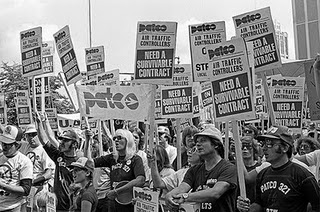 |
| In 1981 Reagan fired all the air traffic controllers who did not comply with his order to return to work, after 2 days of protests over their contract. Reagan showed what class power could do and quashed any resistance. |
That's what class warfare looks like.
If you want to know what redistribution looks like, see the following:
-8 hour workday
-Job benefits including health care and retirement funds
-Public education at affordable costs
Doesn't look like class warfare to me!!!!
Sunday, October 2, 2011
some numbers to ponder
Take a close look at this table, which tabulates sales data for Samuelson's and McConnell's texts between 1948 and 1984.
 |
| From Kenneth Elzinga, "The Eleven Principles of Economics," Southern Economic Journal. Vol. 58, No. 4, 1992, pg. 874. |
While you could argue that there were some isolated years in the mid- to late-1960s when McConnell outsold Samuelson, upon closer look at the edition release years you can see that it's not until McConnell's 4th edition -- in press from 1969-1971 -- that it outsold Samuelson's competing new text, the 8th edition -- in press from 1970-1972. The previous editions of the two texts were certainly competitors, but Samuelson won by a hair in the previous edition wars: 389,000 for his 7th edition vs. McConnell's 378,000.
Also, notice the dwindling sales of the 11th edition of Samuelson (and the long revision date! for a while, both texts were on a 3-year cycle). For the 12th edition, released in 1985, McGraw-Hill brought Nordhaus on board as a cowriter of the text in order to try to reorient the ship. One of the big problems with Samuelson's book was its explicit Keynesian focus -- no doubt a product of the seminal intellectual and political influence of its author, but something which in the end would harm a textbook writer, since one needs to be able to adapt in some way to the shifting political winds (particularly if you're writing in the mid-70s, early 80s!).
Friday, September 30, 2011
dynamics of the textbook industry - a quick thought
Some sentences to ponder regarding the dynamics of the textbook industry, from New Perspectives on Keynes by Cottrell and Lawlor:
Principal features of Samuelson's text remain unchanged over a period of forty-six years. We have argued that Samuelson's 'son' of Keynes was really the product of a virgin birth; it also appears true that, in common with other products of immaculate conception, the analytical apparatus of Samuelson's Economics has remained unsullied by its confrontation with the world. the larger uses of that apparatus have also remained unchanged: Samuelson of the eleventh edition remains the harmonist and neutral scientist of the first edition.The authors are being less praising of Samuelson than they might seem, given this quote. As they observe in a footnote, Samuelson lost significant market power as early as the mid 60s. His text might have been praised as an excellent model of how to educate undergraduates, but that's not all what sells in the textbook industry. Politics and approach play a significant role -- which is a big reason (though not the whole reason) why big-name centrists (Mankiw), or smaller-name economists who keep a close ear to the ground for ideological shifts in the mainstream (what McConnell was), end up being the most successful.
in which n. gregory mankiw demonstrates the irrelevance of his ten principles
This post written earlier today is said by Mankiw to have demonstrated the relevance of his Principle 4, "People Respond to Incentives," but it's very possible students will not see his main point. From the (Wall Street Journal) article:
Yes indeed, and guess what: "citizens usually act so as to fulfill their public duty" is not one of Mankiw's ten principles. So I guess Mankiw's 10 principles don't apply to government workers....
...or to families (who purposely do not respond to incentives when deciding whether to provide you with a home or food on the table) either...
I guess the 10 principles aren't really principles, are they? Either that, or whatever world Mankiw is envisioning in his textbook is a cold and barren wasteland.
Top officials, in a bid to meet goals to win promotions or thousands of dollars in bonuses, directed many employees to refrain from issuing decisions on cases until next week, according to judges and union officials. This likely would delay benefits paid to thousands of Americans with pending applications, many of whom are financially needy and have waited for a government decision for more than a year.So Mankiw decided to pick on government officials who responded to a blip in the government calendar by suggesting to their employees that they work less. While this does indeed demonstrate how officials responded to (perverse) incentives (hm... how does "People Respond to Perverse Incentives" sound as a principle?), some students may react by saying, "that's not the duty of government employees! They should be fulfilling their public duty!"
Yes indeed, and guess what: "citizens usually act so as to fulfill their public duty" is not one of Mankiw's ten principles. So I guess Mankiw's 10 principles don't apply to government workers....
...or to families (who purposely do not respond to incentives when deciding whether to provide you with a home or food on the table) either...
I guess the 10 principles aren't really principles, are they? Either that, or whatever world Mankiw is envisioning in his textbook is a cold and barren wasteland.
Wednesday, September 28, 2011
the problem with orthodox economics
As though we needed another reason to make the point!
So, I was reading through an article from the journal of economic education entitled, "Textbooks, Taxes, and Objectivity in Economics Instruction" (always gotta love that word "objectivity" when talking about teaching economics). They present the standard textbook argument that taxes lower social welfare by creating some deadweight loss -- the standard argument of course, where the loss in consumer surplus is greater than the gain in profits. The author then laments that this is usually as far as textbooks take the argument in terms of the chain of logical reasoning.
And then, oh boy, I get to this quote:
I guess cops don't have diminishing returns to scale either -- they can share donuts or something.
So, I was reading through an article from the journal of economic education entitled, "Textbooks, Taxes, and Objectivity in Economics Instruction" (always gotta love that word "objectivity" when talking about teaching economics). They present the standard textbook argument that taxes lower social welfare by creating some deadweight loss -- the standard argument of course, where the loss in consumer surplus is greater than the gain in profits. The author then laments that this is usually as far as textbooks take the argument in terms of the chain of logical reasoning.
And then, oh boy, I get to this quote:
If the textbook discussion... concludes at this point in the example, the student will be left with the impression that the public sector is necessarily a burden on society. A discussion of the benefits of tax-financed public expenditure will give the student a more balanced view.... Before the city council exercised its power to tax, the private demand for police protection was not strong enough to produce any police protection....If [citizens] reveal their preferences for police protection... the social demand for the services of police... can be identified by vertical addition of the private demands of the citizenry.Cops! Really? That's what makes the neoclassical model balanced -- if you see that taxes will in turn fund public goods such as the police which has positive externalities. Take the logic of the model one step further and you might even get militarization for self-defense (and for smashing unions and wall st. occupations -- the pesky institutions are too market-distortionary!!!!).
I guess cops don't have diminishing returns to scale either -- they can share donuts or something.
Sunday, August 21, 2011
it takes a lifetime to learn how to paint like a child
(Subject line is a modified version of a Picasso quote.)
At least, that's the message behind this article which appeared in the NY Times today by Motoko Rich, titled "Fairies, Witches and Supply and Demand" (if you have run out of your 20 articles this month, try typing the article title into a Google search or getting a service such as "NYTClean"). Rich gives many interesting examples, and all it would take is some clever adaptations in order to distill these stories into educational content for first year undergraduates.
Near the end of the article, Rich confronts the obvious question: why is it so much more difficult to find children's textbooks espousing the excitement of competition and market exchange? His answer:
By and large, the economic lessons in children’s books lean left of center. “I think the writers are not particularly sympathetic to or don’t understand how a market works,” said Gary S. Becker, the Nobel laureate who teaches economics at the University of Chicago. “It’s not easy to convey that to a child. It’s not always easy to convey it to grown-ups.”For the most part, the economic concepts conveyed in the books reflect values like generosity and equity rather than competition. Raymond Fisman, an economist at Columbia University, said his 3-year-old daughter’s favorite books teach the importance of sharing and gift-giving, values that might not lead to the greatest wealth in the real world. But, he added, “I doubt that 3 is the age where you start teaching people the brutal economic truths of grown-up commerce.”
At first I thought -- wait a sec! I could do better than that! Not. So. Simple!
But then, after a bit of reflection on the hours I've spent glued to a Harry Potter book, or to some of my favorite games, or better yet, with my family, I came to the conclusion that No, Rich Has it Just About Right. ;)
Wednesday, August 17, 2011
supermarket economics
I was reflecting on the analogies used by economists to illustrate core ideas such as market equilibrium, consumer preference theory, as well as more advanced topics such as the equation of marginal utilities to prices in product market equilibrium, when I began to realize how artificial the supermarket analogy is. (Loosely stated, the supermarket analogy argues that a shining example of how markets work is the supermarket -- a large group of consumers congregating together in order to take part in impersonal exchanges that leave them better off than they would have been if they had to bargain individually with the farmer or manufacturer. Supermarkets therefore increase market efficiency and hence social welfare.)
One example has caught my attention as being a particularly serious example of this fallacy -- Abba Lerner's discussion on product market equilibrium in The Economics of Control. Lerner goes so far as to say that the equation of people's psychological marginal utilities of goods to the prices of those goods, represented in the standard model of market equilibrium, is one of the great achievements of mainstream economics, validating the use of the model in understanding general equilibrium in any market economy. And you can find this story of the triumph of the supermarket analogy anywhere that core economics principles are explained (even Greg Mankiw uses them in his Principles text, e.g. where he asks whether the price of turkey in a supermarket is "just" according to the principles of welfare economics).
Indeed, supermarket analogies constitute a large enough set of ammunition for mainstream economists that I would label that set "supermarket economics", for lack of a better term. (Apparently that term has been used more commonly in other contexts...)
Supermarket economics is deeply flawed because it doesn't address people's most common interactions with economics ideas in their daily lives -- the economics of work and the economics of the home or family. In fact, I would argue that supermarket economics is intentionally used by mainstream economists to mask the more relevant facets of economic life that most people deal with on an ordinary basis.
Think about it like this: even if "supermarket economics" did hold, what percentage of your day is spent in a supermarket? Now what about at work, or at home, or with friends? One of Mankiw's 10 principles states that "markets are usually a good way to coordinate economic activity". But employers don't go around to various islands in a giant market looking for the "right worker" for a particular job, nor do our parents take bids from the highest bidder to see who will be fed on any particular day. Employers plan the coordination of their workforces, and direct their workers not through market incentives but through threats or just because they command authority in the workplace. These are experiences that most of us have everyday -- before we go to the supermarket to pick up tonight's dinner.
My central point is simple but highly relevant to a critique of bourgeois economics. Supermarkets are just an idealized version of an economy: they mask some of the most important aspects of economic life for ordinary people. Standing back and looking at the different economic activities we engage in, we see that direct, impersonal exchange is not the norm.
Friday, August 5, 2011
assume a can opener
N. Gregory Mankiw on why economists might stick to the rational actor assumption even in the face of behavioral economics findings showing that individuals are systematically irrational (pg. 497, Principles 4e):
[E]conomists are themselves are not rational maximizers. Like most people, they are overconfident, and they are reluctant to change their minds. Their choice among alternative theories of human behavior may exhibit excessive inertia. Moreover, economists may be content with a theory that is not perfect but is good enough. The model of rational man may be a the theory of choice for a satisficing social scientist.
And here, to dunk your head in the water, is Jim Crotty on The Realism of Assumptions Does Matter (start at around 4:40 for the relevant discussion):
Thursday, August 4, 2011
success (and failure) in the textbook industry
One of the more fascinating stories in the history of economics textbooks is the persistence of McConnell and Brue's book. McConnell wrote the first edition of his text in 1960 (Brue joined later) and it is still one of the top-selling econ textbooks on the market! It overtook Samuelson in sales figures in 1975 and has maintained a solid presence ever since. How is this possible, and what does it teach us about the future of Mankiw's text?
Such a question cannot be divorced from political, economic, and social context. This may seem obvious, but there are really two sources of change in the textbook market. One is internal: having to do with the dynamics of the market itself, as well as the content and style of the existing texts. If you hear Mankiw or some other orthodox economist talking about why particular texts are successful, they will most likely turn to this flavor of explanation because it tells a story of individualist success and ingenuity in the market -- how textbook writers come up with excellent new ways of presenting economics research in a consumable fashion to first year undergraduate students. People arguing the "internal" view often lack a perspective on why long-term trends and changes in those trends occur.
The second source of change is external: having to do with the social forces alluded to above. (Does a better job of explaining the long swings in a market.) Philosophers and others thinking about the progress of the discipline from the outside are more likely to talk about these sources, but they are just as important (if not more so) than the internal ones. Did the success of Samuelson have anything to do with his commitment to a consumable distillation of the Keynesian mainstream of the time? Most certainly. Did it have something to do with the way he treated the Soviet model and radical economic alternatives? You bet.
So the funny thing is, McConnell always kept in line with social context. For example, in all editions of the text he has included sections at the end of each chapter titled "The Last Word", which included critiques of, say, the mainstream treatment of monopolies by Paul Sweezy. The point was to present economics as having more than one side, to treat that idea carefully, and leave it open to the student to discuss (maybe in class?) the merits of each side.
McConnell and Brue maintained these "Last Words" throughout their textbook, mainly because they were an effective way of presenting an opinionated argument that, in some way, reemphasized the core theme of the chapter. (Samuelson and Mankiw have something like it as well, for a similar reason; it's an effective tool!) But where the earlier editions of "Last Word" had something like a critique of the main theme of each chapter, by the 1980s and certainly by the late 1990s, the editions' "Last Words" were geared more towards an opinionated affirmation of the underlying theme. For example, a chapter on the pure competition model has a "Last Word" on how pure competition maximizes consumer surplus, demonstrating the welfare properties of the pure competition model in a one-page summary of the chapter.
In short, while Samuelson had kept some Keynesian grounding to his text, McConnell and Brue were able to adjust the focus depending on how the majority of economists changed their views.
What does this mean for Mankiw? As I noted earlier, the key invention for Mankiw was the reorganization of welfare economics. This reorganization is a political project in the sense that it "glosses over" key details of the arguments needed for welfare economics to actually make sense. It allows clear applications to the world of public policy. But still, it is, at its core, a right-center book in a world where the mainstream is beginning to shift slowly but surely. As soon as a (mainstream) book comes along that represents economics with more of a political economy focus, more behavioral economics focus, and a better emphasis on the logic (rather than the rhetoric) of core models, Mankiw's position will be in jeopardy.
As a result, I suspect that very soon we will see the downfall of Mankiw's Principles text. But, more on that in another post.
Sunday, July 31, 2011
why do economists disagree?
The New York Times Sunday Review had an article today about social values and science. The article began with a quote from Nobel Prize winning physicist Max Planck:
A new scientific truth does not triumph by convincing its opponents and making them see the light, but rather because its opponents eventually die, and a new generation grows up that is familiar with it.
The thesis of the article is simple and powerful: scientists who fully embrace their social values when doing research will come out doing better research for it. Instead of purporting to be more "scientific" than the opposition, researchers should explicitly note their social biases, because by doing so, we will approach a higher quality of science: when the social implications of economists' research are explicitly given ("thrown on the table"), so that they are held to be accountable for their ideas, economics will be the better for it.
It's time we started teaching undergraduates a broader view about why economists disagree. Mainstream texts often choose to present the market-centered view as a place of common ground for any group of economists and policymakers who disagree about how we ought to move forward. The "scientific" or rigorous justification for this choice is the welfare economics vision of the economy: i.e., that perfectly competitive markets maximize social welfare and are therefore socially optimal. Welfare economics has succeeded in an uncountable number of ways: from the clever mathematical articulation of its core ideas in the middle of the 20th century, to more unclear (though equally successful) treatments of the ideas in modern economics textbooks.
An alternative view argues that this baseline is an inappropriate way of addressing the concerns of workers, or the poor. For them, the terms of debate ought not to be defined by markets and market efficiency criteria: even if one admits that we are far from the social optimum, this "third view" believes that we should not discuss policy in terms of getting closer to that criterion of social welfare.
The punchline? Liberals and conservatives are both equally at fault for purporting their underlying economic model to be one of science, or even for trying to argue that views can be boiled down to a nice dichotomous world. A broader perspective on how economics is a pseudo-science would admit of more diverse views, and ultimately, better debates.
Economics -- indeed, the world -- would be much better for it.
Friday, July 29, 2011
employer control and theories of unemployment, illustrated

Image source: Terry Everton
Ever known someone, such as a parent or friend, who has lost their job, or who has remained unemployed for an extended period of time? Traditional theories of unemployment argue that your friend is unemployed because he or she is too lazy or lacks the skills to make him or herself marketable to employers. In the above picture, we see a different theory illustrated: namely, that employers use the threat of unemployment to increase the productivity of their workforce. As employers lay off workers, labor productivity increases. Similarly, as unemployment falls, workers feel more secure in their jobs causing them to slack off. The fluctuations in unemployment are thus at least partially a cause of employers' desire to control their workforce.
Hat tip to Ian Seda at Los Expatriados for linking to picture, which was originally found at Monthly Review here.
Tuesday, July 19, 2011
||: a political project, not an intellectual one; a political project, not an intellectual one ... :||
Those are meant to be repeat signs, by the way.
It would be interesting to read your views on what science is.
It's clear what is going on here, with this comment. Consider: Person decides to examine exhibit A. Exhibit A is mainstream economics, purporting to be a scientific theory well-grounded in evidence. Person looks at exhibit A and critiques it. Person can do so on many different grounds, obviously, but one of the most important methods is through the observation that something about exhibit A is logically inconsistent, according to the laws of science (i.e. according to what we actually see in the world, or according to the logic of the theory).
Unfortunately, by doing so, Person is implicitly using a set of his own standards (namely, those of "science") in order to judge the "scientific nature" of exhibit A. But science is not an objective concept in economics or in any field because political ideology also defines what "mainstream economics" is. The question thus arises: maybe Person himself has flawed standards of what "science" is! Perhaps even MORE importantly, perhaps Person's faith in scientific reasoning is representative of a person's faith in a politically charged "idea" of science itself! Fortunately, the main point of my criticism is not to judge exhibit A against what I purport to be "objective" standards of economic science. But I need to explain this a bit more.
Still -- touché. Good point. I should not be simply saying that "Mankiw's text does not hold up to the objectives of science", because that would be saying that if economics were more scientific, everything would be fine. But of course it wouldn't be that easy, because there is a component of ideology to the study of economics!
Fear not reader, I dare not go down the path of holding Mankiw up to standards of science which I myself do not believe in. And actually there are a couple reasons for that. First of all, it's cheap. Mankiw is a textbook! While there are of course some basic standards of logical rigor to which we all must tie ourselves, textbooks are not AER articles and therefore I am not going to pick on Mankiw for small slips in logic.
Second, and more importantly, is that I need to outline my full thesis as a process of steps so people don't jump on me for things I never meant to do in the first place. That is, the extent of my analysis is meant to go much further than simply making a point about logic or rigor. I plan to do the following:
- Examine the discussion of welfare economics
- Make some observations about how Mankiw tells his story, making note of both major and minor logical slips along the way.
- Wrap it up by thinking Seriously about the overall picture of general equilibrium that the student walks away from after reading this section
- Consider the political achievements attained at that point
In other words pointing out the non-rigorous nature of Mankiw's style is not the main point of my argument. However, I do think it's important to think about how welfare economics can be taught correctly, that is, in the sense that each proposition follows from prior assumptions and propositions. But that is not because I see any intrinsic value to the logical consistency of the welfare economics model. It's because of what the welfare economics model purports to be. That is, I would like to stress its political significance in the realm of economic thought.
Here's the clincher: That last point is very crucial to me because welfare economics is really a great political achievement. I don't think you would deny that, would you? The welfare theorems are really the epitome of the utopian vision of capitalism, a point expressed in numerous commentaries on them. Thus, by subverting the logic of the welfare theorems, as Mankiw does, he really is making a great political achievement.
He's essentially subverting the political overtones of them, which is essentially political indoctrination in disguise! For another example of the subversion of the political ideas, consider what happened in the 1940s and 50s with the mathematization of the welfare theorems -- that itself was a subversion of the political overtones because the mathematics is meant to bring the whole thing to a class of Higher Truth shared with mathematics and logic.
And this all goes back to my previous post regarding Lerner's verbal run-through of the general equilibrium model (for two people) in the 1930s. In that post I attempted to argue that the reasons why Lerner brought up the discussion of the way a perfectly competitive system would work with money was not necessarily in order to provide any substantive logical critique of Marxian economics; rather, the point was a political jab. All along.
Really an amazing story if you think about it, but you can trace these kinds of stories throughout the history of non-Marxian economic thought.
Sunday, July 17, 2011
"social" welfare: introductory dialogues
The concept of social welfare is hardly "social" at all. Once again the market takes center stage; and we are left wondering whether any social institutions could possibly exist in the bizarre world that Mankiw is painting for his readers. Yes, of course the model he sets up is meant to idealize in order to get to the core issues. But as we will see, Mankiw discusses the model in a way that leaves the student without any methodological framework for actually understanding those tools, except at a superficially wrong level.
We arrive at Chapter 7.
Behind this question is the following general idea: suppose we were to find some way of measuring the maximum amount of social welfare derived from an individual's consumption of a particular commodity. In equilibrium, the commodity will be sold at a stable price and with a stable quantity. Now, we know that when you consume more of a particular good, the additional satisfaction you get from consuming it diminishes. Thus, if you buy 5 apples at $1, that first apple was worth a lot to you, the second not so much, and so on. Mankiw wants to find some way of measuring exactly how much that first apple was worth to you, plus how much that second apple was worth to you, ... and so on. We know that the last apple, the 5th, is worth $1 to you because we assumed that to be the equilibrium price: you consume apples up to the point where the benefits of an additional apple equal the cost (or price) of an additional apple. So, what is the sum of all the positive values in between?
That is the concept of consumer surplus, or "CS" as we will call it for the remainder of the post.
...
Question: That seems easy enough to understand. But how does "society" fit in here? We were told by you in a previous post that society has no actual agency in the market, that it's really all about market mechanisms. But now you're telling us that Mankiw wants to judge whether the price of the good is "just" according to society. How does that leap take place?
Answer: The key lies in a concept that is not developed in Mankiw's presentation, thereby leading to the confusion. The key to clearing up your confusion is in coming up with a definition of "social welfare". That is, we need to define social welfare in an economy in order to say that markets maximize "social welfare"! The point is simple, and yet extremely crucial, at the same time.
Question: That seems like a simple problem to solve, though. We can measure the CS of any one individual by figuring out how much that individual values each apple. We just survey him or her (theoretically speaking) and come up with a number in money terms. Why don't we just do that for all consumers in the economy? Since everything is measured in money terms, we have a common unit of measurement. So we just add everything up! What's wrong with that?
Answer: There's nothing wrong with that, by any objective standard of right or wrong. But I do think that you need to realize what implicitly you are doing when you propose that measure of social welfare.
Recall first something that was mentioned at the beginning of this chapter of Mankiw: i.e. that we are now in the normative world of economics: what ought to be. Therefore, in your answer to me, you are implicitly saying that society ought to define social welfare as the equally weighted sum of all individually-summed CS's. That's a very big task you've taken on there!
First of all, you're arguing that your weighting scheme: " 1*(CS of consumer A) + 1*(CS of consumer B) + 1*(CS of consumer ...) + 1*(CS) + ... = SW" is not arrived at democratically or socially in any sane sense of the term. Rather, you're positing that that weighting mechanism is just how you think we should add things up to determine welfare.
Second of all, it's pretty arbitrary, don't you think? We've said that each person is unique in society. For example, some people are poor, and constrained much more by their budgets than other people. So, might there be a social welfare function that captures this fact more accurately? Think of person A and B: person A spends 90% of her income on food and other necessities (like turkey) while person B spends only 40%. How will a change in the price of turkey affect these two people? Most likely, it will affect them wildly differently.
Therefore, when you say "Competitive markets maximize social welfare" You are really saying "competitive markets maximize social welfare according to my definition of social welfare". That's not very "social".
Question: OK, let's step back here. Where does this leave Mankiw's original claim about society? All you're telling me is that society is arbitrary, or biased against people who are income-constrained. But "society" can't please everyone. Doesn't this at least give us a baseline?
Answer: No. In a text that purports to be scientific and based on measurement before theory, Mankiw 100% fails. There is nothing "scientific" about choosing an arbitrary weighting scheme and defining it as social welfare. There is also nothing "social" about it, since we are assigning this weighting scheme insulated from democratic processes which modern market economies are supposed to be all about.
We leave, for a separate post, the treatment of the social planner by Mankiw. To give the brief bottom line: it is a wild ride that involves a lot of intellectual thrashing about in the dark, making little sense and certainly not "enlightening" the student to anything regarding market processes or the significance of public policy in the real world.
Friday, July 15, 2011
turning the history of thought on its head, then reducing it to 3 pages not simply by summarizing but by ripping out the N-3 pages in between
Comments most welcome in what is to follow: the beginning of a multi-part series on the treatment of welfare economics in Mankiw's Principles of Economics. In his attempt to substantiate the claim that "society" is responsible for the distribution of income in an economy Mankiw fumbles the point, leaving us with a mess of confused statements and lines of thought. Anarchy ensues and the textbook abandons all hope to be perceived as an intellectual achievement (a political achievement, yes).
In a story that is still in the process of being uncovered, we have a startling discovery in the history of economics education in which the ideas and tools of welfare economics take early and center stage in the most popular principles of economics textbook currently around, by N. Gregory Mankiw.
Normally, welfare economics comes toward the end of any serious study of neoclassical economics. This is as it should, since many ideas and intuitions need to be developed before the student can even approach the idea of general equilibrium. The early placement of the subject of welfare economics (chapter 7 in his Principles text) is seen as an innovation by Mankiw: it allows students to see, early on, the applicability of the core ideas of mainstream economics to public policy.
But we think it's just a more convenient method of pushing the bourgeois ideology: the chapter is innaccurate according to any respectable take on the history of economic thought, full of conflicting and confusing statements, and yet confident throughout that it carries the stamp of approval of the "majority consensus" in economics. As such, Mankiw's act represents a significant turn in the history of economics education and of the bourgeois political project more generally: an exchange of scientific or "rigorous" dignity for, well, none at all.
Mankiw defends against the traditional ordering (i.e., the leaving of normative issues of consumer and producer surplus, social efficiency towards the end of the book, or by not including them at all) in classically bourgeois, non-rigorous fashion: early exposure to welfare economics 1. gives a better appreciation of supply and demand; 2. gives an "intuitive" grasp of market efficiency; 3. gives policy relevance (?) to the neoclassical model by using it as the baseline. As it is clear from these points, Mankiw does not place welfare economics early in the book because later concepts depend on it and build on it logically (cost of production does not build on welfare economics, methinks).
Mankiw sez that the former teacher of Ec 10 at Harvard, Martin Feldstein, originally came up with the idea of introducing welfare economics earlier because of his personal interests in public policy. Indeed, there is no reason, other than pure utility to the bourgeois economist, for putting welfare economics so early in the text. Up until chapter 7 (that is where welfare econ is first used), in fact, not much in the way of following the "scientific method" (which he purports to exploit throughout the text with the line 'observation, theory, observation') is invoked at all:
-The first chapters, as we have seen, are just Mankiw talking about how to think like an economist
-And then he spends a chapter talking just about a made up story, complete with dialog, where ranchers and farmers can trade and take a comparative advantage.
-After a drawn out chapter on supply and demand and the concept of elasticity, he brings government in by discussing how it can effect supply and demand through price floors.
-Then comes welfare.
It gets worse. The standard Marshallian method of calculating consumer and producer surplus (CS, PS heretofore) is flawed. While Hicks' reformulation saves the term in the end, it is not without significant qualifiers on Marshall's original formulation of the concept, so that any reference to the (albeit simpler) model of Marshall is incorrect. CS, for example, is not so easily the area under the market demand curve because that would a cardinal measure of utility (each person's utility in consuming a good can be compared with another person's utility in consuming the same good). If person A spends a large majority of his income on bread compared to person B, then an extra dollar might mean more to person A than it does to person B. Mankiw, of course, uses a rare Elvis Presley album as his example of consumer surplus (what various people are willing to pay for it) so he conveniently skirts the issue. But in fact, he never mentions the problem to begin with.
Remark:
The way that some early economists tried to get around this argument is just fascinating. Lerner (writing before Hicks' innovation), speaking more generally about the welfare properties of general equilibrium, tries to argue that we must accept that "the satisfactions experienced by different people are similar in the sense that they are the same thing" because otherwise, we "deny meaning even to the assertion that anyone other than myself is capable of feeling any kind of pain or pleasure" (25). It is by far the most confusing paragraph in the chapter. He attempts to deride "philosophers" who question how we can know that each person experiences utility from the same good equally but he gives no hard facts. All he says is "that the satisfactions experienced by different people are the same kind of thing is incapable of proof". Observation, Theory, Observation, indeed.
Others, including Marshall himself, simply assumed that each person spends similar (small) amounts on each commodity.
End Remark.
How ought welfare economics be taught, then? (We touch on the point briefly here, but it will certainly gain more attention in upcoming posts.) From the ground up. There's a lot of consumer choice and production theory to get through before we can even think about normative properties of our model. As observed earlier, the entire edifice of the welfare model is cracked and beaten and is probably built on a few fault lines too. We should just get rid of the fairy tale stories implicit in this old horse. But for now, it is important to get to the basics: see how the culture of bourgeois economics works in modern education: turning the history of economic thought on its head, stripping it down to a few pages, and ripping out everything else in between.
Some of the ideas of this post were taken from scholarly articles, including one by Miroslav Svoboda found here. The history of CS and PS is well-known but Svoboda has some interesting anecdotes in their account of the story. They will be elaborated upon in subsequent articles.
This post draws on Mankiw's remarks on "Teaching the Principles of Economics," which appeared in the Eastern Economic Journal, Vol. 24 No. 4, Fall 1998.
Closing the first of this multipart series with the observation that teaching the "right" form of welfare economics is both the right and terribly wrong answer to our troubles. "Right" because the lack of a coherent logic to the idea as presented in the text means that many students, who are not taught the importance of assumptions or even their accuracy, will accept the story. "Terribly wrong" because, even as taught correctly, it is still a horribly misguided understanding of how an economy works.
The contradictions, inaccuracies in this great story are still to be revealed...
Wednesday, July 13, 2011
addendum: stories?
Of course, the idea that NC econ is built on stories is not a new one; McCloskey made the point nicely in The Rhetoric of Economics over 20 years ago and Steve Cohn, professor at Knox and UMass Econ PhD, has argued in "Telling other Stories" that that's precisely what heterodox economists need to do: tell stories which are anti-Mankiw.
Look, you either stress the rhetoric or the "rigor", and you are either orthodox or heterodox.
-Orthodox rigor people are the "positive economics" people out there, people who just want orthodox economics on some "scientific" footing, whether that be more math, or better statistical analysis, or what have you.
-Heterodox rigor people are similar. They want to fight NC economists by "beating them at their own game" -- becoming better mathematicians or statisticians or historians than the orthodox economists, and answer heterodox/left-leaning questions in the process to jet them out.
-Orthodox rhetoric people are the welfare economists, the economists who quite consciously seek to propagate mainstream theory. Mankiw, for example. At the very very top of the ladder, these people often blur with the orthodox rigor people because they are just so good at everything. (Duflo, Acemoglu come to mind).
-Heterodox rhetoric people are the political activists, Marxists, anarchists out there who realize that there is a political battle to be won here and it won't just be won in the ivory tower. We need to raise awareness of fundamental wrongs in the economy and push for the smashing of capitalism and its institutions. At the very very top of the ladder, again, these people often blur with heterodox rigor people (Bowles... and not an economist but I would of course put some public intellectuals like Harvey or Chomsky or those guys at Wisconsin Soc/PolSci(?) in this group).
So in short, Cohn's view (mine as well) is that we need to come up with some good rhetorical strategies taking the form of anecdotes or stories which frame things from a workers' point of view. (McCloskey, on the other hand, believes we need to move in the 'scientific' direction in order to save NC econ.)
Cohn's list of stories is quite exhaustive, including Robinson Crusoe (apparently he owned a slave who was the other person on the island in the NC version of the story), Diamond/Water paradox, and "supermarket" analogies of an economic process rather than "workplace" analogies (even so-called "liberals" such as Brad DeLong are guilty of this fault, for example when he tries to analyze Polanyi's concept of a disembedded market *facepalm*). Needless to say, there is a lot of room for good ideas here.
We move next to a striking example of NC econ stories in action, one that has profoundly earth-shattering effects on Mankiw's text.
This article drew from Steve S. Cohn's "Telling other Stories: Heterodox Critiques of Neoclassical Micro Principles Texts", GDEI Working Paper 00-06, August 2000. Link here.
Tuesday, July 12, 2011
the culture of the bourgeois
Any culture produces stories, myths, and other traditions with the intent of reproducing itself in society. Economics is no different. Economics attempts to reproduce values that serve the interests of certain wealthy individuals in the capitalist economy (capitalists). This is not a new idea: capitalists itself would admit to it. But, like the creation myths of religions, we can question the truth of these stories with cultures and stories which are not so easily heard, precisely because they are against the status quo, with powerful results.
Therefore, it is very important to realize that when we see the proliferation of stories in economics -- whether it's "Vinny the vegetarian and Mark the meateater" who trade goods so as to equate their marginal utilities with the prices of the goods, or "Sam the farmer and Ralph the rancher" who specialize in their work in order to exploit comparative advantage -- it is very important to realize that there is a culture behind all these stories, attempting to reproduce itself throughout society. Just as religions spread themselves through introducing their texts and practices to new potential members, and just as any culture has its own set of traditions which, once known and practiced by an individual, signifies the individuals membership into a group, understanding in and believing in the central stories told in economics will lead you on the path towards being an economist (or at least, being accepted within their culture).
The problem is, of course, that the stories of economics are incongruent with reality, even when its practioners never cease to argue in favor for them.
Remark: Whenever I read these "stories" I am really amazed at how unbelievably untrue they are -- even while its author is arguing for them until he is blue in the face. For example, in Abba Lerner's The Economics of Control, he explains the classical model of general equilibrium (i.e. the allocation of goods and services in a competitive economy in the case where N=2). He explains, on page 20, that "[the optimal allocation of goods in a competitive economy] seems so obviously what happens in the existing free market economy that all the rigamarole about marginal substitutability and barter exchange would appear quite unnecessary. There are two reasons," he goes on to say, "why all this argument is not unnecessary."
That is, he gives two justifications for why we need the competitive model.
They are far from satisfactory based on any standard of logic or rigor.
The latter argument he provides is that such a model is necessary because it is the foundation upon which later results are built. Fair enough -- surely insane conclusions may derive from any number of laughable premises.
The former argument is more intriguing. "The first reason," Lerner begins, "is the horror that many socialists have of anything that reminds them of the existing capitalist world. This makes it necessary to show that the usefulness of money as a means of bringing about a good distribution of goods is not merely a bourgeois belief carried over uncritically from experience under capitalism but can be shown to bring about desirable ends by a consideration of fundamental principles" (21). But the Marxian critique of money as a basis for exchange is based on the fetishization of commodities and the principle differences between exchange value and use value of those commodities (particularly, labor). But nowhere in Lerner's discussion of a market economy does he address the Marxist critique of capitalist exchange.
My point is that, according to Lerner's discussion, the theory of the optimal allocation of goods in a market economy is not a substantive critique of socialist policy; rather, it is viewed by Lerner as an ideological attack on (or defense against) Marxism.
That changes the game considerably -- and it highlights the important point made above that these are stories which are told over and over in order to reproduce the ideology of traditional, bourgeois economics.
End Remark
For over a hundred years, since at least the time of the response to Marx's Labor Theory of Value, proponents of mainstream economics have actively recognized that their project is a political one. Thus, the bourgeois culture behind economics tells stories which aim to reproduce the system's core beliefs, even though those beliefs are far from universally true. And, in a surprising twist, most economists will not even admit that they are not being rigorous even though it is obviously true that they are not being rigorous.
Subscribe to:
Posts (Atom)