Showing posts with label teaching. Show all posts

Tuesday, July 3, 2012

making path dependence history

Words to think about:
But there is another reason why the historians of the past should be taken seriously. A good knowledge of historiography—and the same could probably be said of the history of economics or the history of sociology—greatly diminishes the current practitioners’ claims to being innovative. When economists say that “history matters,” they invariably think of “path dependence,” the concept introduced by Paul David (1985) and often cited as if it was a Copernican revolution. This idea not only is not new but had already been shown to be unhistorical at least seventy years ago. In his The Historian’s Craft, published posthumously in 1949, Marc Bloch warned against the “idol of origins,” which leads to “confusing ancestry with explanation” (p. 27). Just as the seed from which it develops contains the destiny of a plant only to a minimum degree, so the history of social facts results from forces that are not found in the “initial conditions” to any great degree and whose effects are not propagated automatically.
From Boldizzoni's excellent The Poverty of Clio: Resurrecting Economic History, Princeton University Press, 2011.


The spectre of "path dependence" haunts a large amount of modern research on economic history. Perhaps that is due to its close association with physical sciences and mathematics (path dependence is, after all, really a concept derived from the science of particle motion).

But Bloch is ultimately correct -- ascribing the success of something today to a few determinist factors many, many years ago is not really history. At best, it is a convenient excuse to not talk about political power's influence on the success of a particular idea or institution. At worst, it's an apology for all the evils that allow an institution to persist.


So instead of making path dependence a part of economic history, let's make path dependence history, in the sense that we no longer fall back on it as an explanatory variable when in fact it is not one at all -- as Boldizzoni remarks, a multitude of other paths always exists, and seeing why others fail or succeed throughout history is the real task of economic historians.

Monday, May 7, 2012

fun legal quote of the day: sailors be damned!

Justice Waite rules in Matthews v. Terry, 10 Conn. 455 (1835):
There is no doubt but that, for just cause, a parent may reasonably correct his child, a master his apprentice, and a schoolmaster his pupil. Yet that power cannot be lawfully exercised, by a master over his hired servant, whether that servant is employed in husbandry, in manufacturing business, or in any other manner, except in the case of sailors.
Sailors have a long and brutal history re: labor law. Richard B. Morris, for example, writes of the continued use of labor controls (imprisonment for contract breach, fines, etc.) on seamen into 20th century Maryland -- long after the use of indentured servitude (and of course slavery) had disappeared from the region.

Sunday, April 29, 2012

learn american economic history online this summer

This summer, learn why they are the
backbone of American prosperity.
For regular readers of the blog, you might be interested to know that I am teaching an online course this summer through the UMass Economics Department, on American Economic History, from June 5 - July 10.

If you're interested, or if you know of others who might be interested, you should pass along this advertisement to them. You can sign up online at  http://www.umassulearn.net/classes/summer-2012?clid=9444&view=class.

If you've been reading the blog regularly, you know what this course is going to be about: economics from a social-historical perspective, with an emphasis on the ways in which social conflict has helped shape economic institutions such as the market, firm, the state, and even the environment. We will use a variety of tools to answer tough questions -- including statistical analysis, economic theory, and (of course) historical method.

Grading will be through papers and discussions, drawn from a rich reading list of social, labor, and economic history.

Please pass along to anyone you think might be interested in taking the course. And I'm glad to answer any questions! Leave a comment on this post or send me an email. For more information about my teaching credentials and approach, see this link: https://sites.google.com/site/dpmacdona85/home/teaching.

Saturday, March 24, 2012

39 stripes

A slave code from Alabama (1852) reads:
#993. The patrol has power to punish slaves found under the circumstances recited in the preceding section, by stripes, not exceeding thirty-nine. 
(The "patrol" was the officer in charge of making rounds on the various plantations to catch slaves who were off their master's plantation without permission or who were simply loitering. Any white, male slaveowner below 60 years old were required to be available for patrol duty -- seems similar to jury duty today.)

Why 39? The number comes from the amount of lashes Paul received from the Jews, according to 2 Corinthians 11:24. Jewish executioners were not allowed to go above that amount of lashes according to the law of Moses (later codified into Roman law). 40 lashes was considered a death sentence.

Monday, March 5, 2012

legal history teaching materials

Someone who commented on my previous post asked for the reading list for the course I'm teaching on law, labor, and capitalism. I linked to it back in January -- you can find the post in which I linked to it here.

In addition to the reading list, I've uploaded two more items (both PDF). The first here is slides from a lecture I gave on the history of police in American history (inspired by Christopher Tomlins' research on the subject), titled "'F*ck tha Police'? Law, Institutional Change, and the American Revolution". The second here is a lecture on the relative autonomy thesis as applied in Morton Horwitz's brilliant Transformation in American Law, 1780-1860. The title of that one is much less interesting: "Relative Autonomy and Historical Materialism in Horwitz's Transformation in American Law".

Just a brief note: the field of legal history is ripe for economists' picking. It is indeed due time to revive the idea of a "law and economics for the left", or a "radical law and economics", or maybe simply, "heterodox law and economics", something in the spirit of the early 20th century Commons-esque old institutionalism, but updated with a more interdisciplinary and stronger theoretical outlook. I humbly consider my dissertation as one step in that direction -- we'll see where that goes.

More on these issues when I get around to getting them out of my head and putting them down somewhere.

Saturday, February 4, 2012

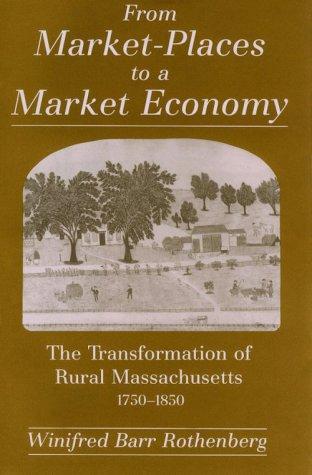
reconsidering rothenberg's from market places to a market economy, 20 years later: part I of a series

In this first installment of a series on the transition to capitalism in early America I am going to look back at one of the most influential books on the market revolution, Winifred Rothenberg's From Market-Places to a Market Economy, published 20 years ago. Rothenberg's work has since been read as a kind of "textbook" for understanding the liberal perspective on economic development and has (at least, I am told it has) been studied carefully by high-powered development economists at the World Bank and other organizations to help inform the crafting of development programs in the developing world, such as the Washington Consensus. Thus, given the importance of her work and its longstanding influence, I am going to reconsider her thesis in light of more recent work that has forced us to question some of the crucial premises of her hypothesis that the freeing up of (product and labor) markets laid the bedrock for industrial development in the early-19th century Northeast.

We note briefly that the premise of Rothenberg's thesis clearly depends on the widespread prevalence of local regulatory regimes of both product and labor markets in the 18th century, particularly the early 18th century (given that her observation of increasing market integration begins around 1750). To support that thesis, she draws primarily on quantitative data. Further qualitative support is found in the so-called "Whig" historiography of the American Revolution, of which the quintessential proponent is Gordon Wood's Radicalism of the American Revolution (1992).

For Wood, the American Revolution was radical in its assertion of a popular basis for politics. For Joyce Appleby, a scholar writing along similar lines, its importance for political economy was in its emphasis on liberalism as an economic philosophy -- stressing private property rights, enforceable contract, economic independence, and a laissez-faire theory of government policy. A corollary of this thesis is the rise of a free market mentalitie, as Rothenberg put it -- a rise in the value of free markets and trade for mutual gain among the newly democratic society. Rothenberg finds quantitative evidence of this assertion in the regional convergence of market prices for various agricultural goods as well as the rise of contract labor in the Northeast in the late-18th and early-19th centuries. Her analysis draws from account books, diaries, and prices taken from newspapers. A key aspect of her thesis is the rise of free contract labor and free labor more generally, as distinct from the coercive institutions of the early 18th century. The question to be answered there is, Did the American Revolution give rise to what we would eventually see as the "free labor" necessary to fuel the fire of the Industrialization of the North? Rothenberg answers with a resounding "Yes". Others have their reservations.

Writing from a different perspective, Morton Horwitz's 1977 Transformation in American Law had a chapter on contract law which suggested (but did not prove) a counter-hypothesis. Sifting through court records and treatises he finds that not only was labor subject to a set of legal controls in the early 19th century significantly curtailing its freedom to contract and its mobility, but that the law exhibited a clear class bias against the worker and in favor of entrepreneurship.  Taking issue with Horwitz's thesis in her own 25-year-later reconsideration (published on EH.net here) of Transformation she shows how many of the claims of class bias and worker unfreedom in Horwitz have not withstood more recent, closer examinations of the actual application (or more appropriately, lack thereof) of some of the seminal labor cases upon which Horwitz relies. (See Karsten's Head versus Heart for a good summary of right-to-quit law in the Northeast.)

Time to put race at the center of labor
history in the U.S. instead of  unfree white labor?
At this point, it seems that Rothenberg has the upper hand. Several other labor law histories centered on the Northeast accepted the basic claim that the American revolution was marked by a fundamental embracing of political equality, throwing off the institutional fetters of an unfree and coercive colonial America (including the legal system!). Indeed, if we are to question at least the labor market-side of her thesis, it behooves us to either find some more empirical evidence to support the Horwitzian argument about labor control in the early 19th century, or to reconsider the labor law history of the colonial era to see in what ways labor ever was unfree or coerced or regulated -- or we could do both.

In the next part of the series, we will see how recent historical research has questioned precisely the points mentioned in the previous paragraph, seriously calling into question whether labor developed along an essentially government-free trajectory in the early Republic.

Thursday, October 27, 2011

thought of the day: radical economics and intro textbooks

Reflecting on yesterday's post, which had a quote that was admittedly out of context, I started thinking about how Mankiw treats neoclassical theory vis-a-vis other economic theories.

Of course we know that Mankiw intends to present the consensus view of the mainstream of the economics profession, which is (apparently) why he pretends not to be making any conscious decisions about what to include in his book. Rather, he can say that he doesn't mention radical economics because the mainstream no longer engages with radical economics.

But, my point yesterday is partly that we are taking this intention of presenting the consensus for granted. Samuelson, as it may or may not be evident from reading yesterday's quote, felt as though he needed to address Marx and Marxism on their own terms. He actively engaged with "the old man", pointing out what he thought were both the strengths and weaknesses of his ideas. And as one of my professors at UMass Econ (who is an MIT PhD) would tell us in class, Samuelson was always bringing up Marx in his graduate classes! You would walk in the room, hear this guy talking about Marx, and wonder where the hell you were. One certainly does not find that kind of active engagement with radical economics in graduate courses at the top schools today.

But, there's a flip side of the coin. At times, Samuelson fails to accurately portray Marxist ideas. Just as Mankiw sometimes glosses over core logical steps in neoclassical economics, so Samuelson did similarly with Marxism. And that kind of treatment may be as bad, if not worse, than not talking about him at all (a la Mankiw -- who does not mention Marx a single time in his intro book).

The question is, which is worse? No mention of Marx, or mention some things about him, get some things right, and some things wrong?

What do you think?

I tend to believe that some mention of Marx, even if it's not the best portrayal of his ideas, is the best option for effective pedagogy. And I would say, as a kind of meta-analysis of economics textbooks,  that there is something to be said about the evolution of bourgeois ideology that they do not even actively recognized the existence of this countervailing force in their intro textbooks.

The question I leave you with is the following: what does choice of reducing exposure to Marxist ideas imply about the state of bourgeois economics? From the perspective of instruments of bourgeois ideology (an extremely important point to keep in mind), have Marx's ideas become more politically relevant than they were in the 1960s, thus, the need for more forceful repression of them? (This could mean that class struggle has become more acute in society since the 1960s.)  Or have the instruments of bourgeois ideology simply found a more effective (efficient, whatever) means of dealing with radical theories? Are both ideas right?

What do you think?

Wednesday, October 26, 2011

quote of the day

Marxism may be too valuable to leave to the Marxists. It provides a critical prism through which mainstream economists can -- to their own benefit -- pass their analyses for audit.
Samuelson, Economics [Introductory Textbook], 9th Edition (1973), pg. 866

How the world has changed.

Sunday, October 16, 2011

will write a paper on this, someday...

...But until I do, you should all send me your comments on the following idea :)

Google ngram for "Think Like an Economist" and "Thinking Like an Economist"

Monday, October 10, 2011

columbus day


Arawak men and women, naked, tawny, and full of wonder, emerged from their villages onto the island's beaches and swam out to get a closer look at the strange boat. When Columbus and his sailors came ashore, carrying swords, speaking oddly, the Arawaks ran to greet them, brought them food, water, gifts. He later wrote of this in his log:
They ... brought us parrots and balls of cotton and spears and many other things, which they exchanged for the glass beads and hawks' bells. They willingly traded everything they owned.... They were well-built, with good bodies and handsome features.... They do not bear arms, and do not know them, for I showed them a sword, they took it by the edge and cut themselves out of ignorance. They have no iron. Their spears are made of cane.... They would make fine servants.... With fifty men we could subjugate them all and make them do whatever we want.
These Arawaks of the Bahama Islands were much like Indians on the mainland, who were remarkable (European observers were to say again and again) for their hospitality, their belief in sharing. These traits did not stand out in the Europe of the Renaissance, dominated as it was by the religion of popes, the government of kings, the frenzy for money that marked Western civilization and its first messenger to the Americas, Christopher Columbus.

From chapter 1 of Howard Zinn's A People's History of the United States (pg. 1)

(Yes, this was posted last year on the blog as well...)

Wednesday, September 28, 2011

the problem with orthodox economics

As though we needed another reason to make the point!

So, I was reading through an article from the journal of economic education entitled, "Textbooks, Taxes, and Objectivity in Economics Instruction" (always gotta love that word "objectivity" when talking about teaching economics). They present the standard textbook argument that taxes lower social welfare by creating some deadweight loss -- the standard argument of course, where the loss in consumer surplus is greater than the gain in profits. The author then laments that this is usually as far as textbooks take the argument in terms of the chain of logical reasoning.

And then, oh boy, I get to this quote:
If the textbook discussion... concludes at this point in the example, the student will be left with the impression that the public sector is necessarily a burden on society. A discussion of the benefits of tax-financed public expenditure will give the student a more balanced view.... Before the city council exercised its power to tax, the private demand for police protection was not strong enough to produce any police protection....If [citizens] reveal their preferences for police protection... the social demand for the services of police... can be identified by vertical addition of the private demands of the citizenry.
Cops! Really? That's what makes the neoclassical model balanced -- if you see that taxes will in turn fund public goods such as the police which has positive externalities. Take the logic of the model one step further and you might even get militarization for self-defense (and for smashing unions and wall st. occupations -- the pesky institutions are too market-distortionary!!!!).

I guess cops don't have diminishing returns to scale either -- they can share donuts or something.

Thursday, September 22, 2011

empirical analysis of class conflict -- some current research

Consider this post to be the first in a series in which I attempt to explain some things I'm currently working on. The problem with stating anything definite about projects is that you risk it coming across the wrong set of eyes. Maybe once I get tenure I'll have a more relaxed tone, but for now (since I haven't even gotten a PhD!), I'll try to write in such a way that doesn't give away techniques, data sources, or references. See my research page here for a list of all current and past projects.

Of course, that stuff tends to be the boring part of any research paper anyway, and when I comment on research I usually avoid technique and references in a New York Times Sunday-esque "pop social science" sort of way, so I guess I'll just try to do that same sort of thing with my own work. Anyway, on to it:

The project I want to write about for the next few posts is both narrow and broad. I started out with a question that hasn't been adequately resolved in the empirical literature, and ended up manifesting about the importance of social context when evaluating model results.

The question: whether under a piece rate (where you get paid based on how much you produce), more productive workers in the firm are prone to work less hard than they should in order to reduce the possibility that the manager cuts their piece rate.

In a firm where all workers are under the same contract, like the one that I looked at, this possibility might arise if individual effort is observable and if workers gain significant experience on the job, or "learning by doing". In such a situation, managers might observe the total output of the firm, decide that productive workers are earning really high rents because the work is too easy for them, and cut rates on everyone in order to stop workers from earning as much and, of course, to keep the profits of the firm from slipping.

The best way to test for the presence such "strategic" individual behavior would be to examine worker effort over time, and see how it responds to changes in his piece rate. Additional information on how long the worker has been at a firm, as well as other factors that might contribute to his or her productivity (how closely is management observing the worker?), would be good "controls" -- i.e., they allow you to tell the fullest story possible by evaluating the contribution of each possible factor to explaining worker effort. And finally, ideally, you would have a lot of workers to look at over a long period, in order to tell a convincing story.

The problem, however, is that if you want to tell a truly convincing story, those are not all the variables you need. Sure, from the inside of the firm, you might be able to explain the relationships among, say, worker effort and how productive he could have been, and then see if he's "lying" on the job. But what if his behavior is also affected by his fellow workers' ideas about why managers are changing their wage rates on them in the first place? A rate cut could mean one thing -- a rate hike, another. Or, what if the worker has to work for a certain amount of time in order to feed his family back home, because it's becoming harder and harder to do so as other options for work deteriorate? These are potentially very significant factors that simply cannot be included in a firm-level research design.

Well, that's it for now. I've outlined the ideal situation for testing the research question as well as a potential problem with that approach. Next time I'll talk a bit more about who these workers were and why running the model in the 1830s might be different from running the model in the 1850s.

Thursday, February 17, 2011

gathering potential quotes for the afit conference

Freedom is neither a legal invention nor a philosophical conquest, the cherished possession of civilizations more valid than others because they alone have been able to create or preserve it. It is the outcome of an objective relationship between the individual and the space he occupies, between the consumer and the resources at his disposal.

Claude Levi-Strauss

Thursday, December 30, 2010

looking beneath the left-right distinction: the tradition of critiques of economics pedagogy

Greg Mankiw made a quick reference the other day on his blog to a panel at the AEA meetings on economics education. He linked to a paper by Lopus and Paringer that compares the leading textbooks on the market today. Here is a link to Mankiw's post, which has a link to the paper:


Here are some bullet point comments:
  • I certainly agree with Lopus and Paringer's claim that Samuelson's book still sets the framework for economics education, even as other texts have superseded it. In content and approach, Samuelson's successors including McConnell and Mankiw are focused on political balance built on fundamental principles of market mechanisms, limited government intervention, supply and demand, and thinking at the margin, among other key features of a mixed economy.
  • But Lopus and Paringer simply miss the big issues when they claim that the main problems scholars had with Samuelson's book (and thus the later texts as well) were that it was either "too Keynesian [or] not Marxist enough" (pg. 3), depending on one's place in the political spectrum. This is a very narrow summary of the debates surrounding Samuelson's books. Marc Linder's criticism of Samuelson in particular is much more fundamental. Shunning the left-right distinction, Linder showed how Samuelson's approach to teaching economics was also ahistorical because it pretended to teach "core" economics concepts of scarcity and market efficiency as if they were God-given aspects of economics. Linder argued that these concepts are actually the product of the particular socioeconomic system of capitalism. In short, by ignoring key changes in the history of economic thought, Samuelson's book naturally fits itself into market rhetoric and, if I might add, indoctrination -- precisely because it does not even question principles and ideas which are not wholly absolute or scientific.
  • It was interesting to learn that McConnell's book overtook Samuelson's in sales by 1975. I thought it was later than that, but it does make sense. It shouldn't surprise anyone because during the mid-1970s a lot of turmoil in the political economy was brewing which led people to question certain basic Keynesian fundamentals. This was also around the time that Harvard started using a different book for its Ec 10 course (i.e., not Samuelson), causing a lot of uproar which has been documented in the Harvard Crimson. The story here goes as follows: after WWII Samuelson had a visiting position at Harvard, but he was denied a full professorship there, purportedly due to the fact that he was Jewish, so Samuelson ended up going to MIT instead. This caused a lot of negative sentiment between the two schools, with one Crimson article arguing that it would take decades for Harvard to recover from their mistake. Thus, when Harvard switched away from Samuelson, this also caused some discontent, seen as another political move against Samuelson and his brand of economics. I talk about some of these controversies more in depth in a post relating to Anti-Mankiw from a while back; you can find it here: http://imagininghistory.blogspot.com/2010/05/in-beginning-there-was.html
  • Of course, the paper finds little difference among the leading books, aside from small differences in the level of mathematics, policy orientation, and range of topics. While some would qualify an important difference in the top books in terms of their hegemony in the field, to some this is not an important distinction. I for one would certainly not argue that Mankiw's Principles is more hegemonic than any of the others, since economics education itself is partly a political project. But it would have been nice to hear more about different methodologies, in particular when dealing with economics education!
  • Paper notes that Mankiw's intro does not address the short run as fully as other texts, and there is no discussion of the Keynesian aggregate expenditures model.
Overall, I was not thrilled with the paper, but it is a useful introductory discussion to different economics textbooks. We still have very far to go...

Sunday, December 26, 2010

political economy of the arts

A very interesting comment thread today over at MarginalRevolution on unions in the Arts. I think that it's a great example to use in a labor history or just a (heterodox) labor econ class. It's a fun example that highlights many of the important themes of trades unions such as protection of trade skills, skilled vs. unskilled issues, and how politics and economics intersect for labor on a macro scale. Anyway here is the link:


I had something to say about the ways in which political entities have historically restricted access to a trade and why we're not necessarily worse off for it. I then drew the grad school analogy, asking "Are grad schools an enemy of scholarship?" to which one person replied, "I could name some that certainly are :)"

Touche...

Tuesday, October 26, 2010

703 10-27

The "old" labor law history around the turn of the century was conservative in the sense that it focused solely on the operation of the institutions -- law, the state, and so on. Thus these works were generally seen as reformist -- they focused on the "successes of the New Deal" and other ways in which workers were able to advance their economic power over employers. Even somewhat radical scholars in this "old" tradition, such as Edwin Witte's work on labor injuctions, was focused, in the end, on how to reform legislation so that the court decisions were more favorable to workers.

In particular, take the classic example of conspiracy law. At the turn of the century, unliked Britain, conspiracy law (the law of labor unions) still held that unions were illegal. This was maintained up until the New Deal when the NLRB was established. Witte, arguing in the 1920s, observed that over the latter part of the nineteenth century court injunctions were increasingly used against striking workers instead of holding full criminal trials. In fact, (I believe this is something noted in DuBois' Black Reconstruction though I'm not sure) the 14th amendment was more commonly applied to businesses during this time period than to blacks for racial crimes.

At any rate, the focus of this older tradition was on reforming law to give workers and unions a broader space for collective bargaining. Concentration was focused on the internal evolution of unions, law, and other institutions.

Interestingly, and I can't understand why this is the case, but there is another similarity among these early institutionalists (including Commons). They focused mainly on the postbellum period -- and in particular, on the 1870s and 1880s -- as crucial turning points in American capitalism. Forbath for example, while part of the "new" labor law history, also focuses on the postbellum period as central for understanding important debates in American economic history, including American Exceptionalism (he also uses many of the same themes as the old labor historians, including the issue of injunctions). I call attention to this fact because the social historians of the 1960s and 1970s, we will see, are much more interested (and rightly so, I think!) on antebelllum developments in political economy.

This was the older "camp". The "new" labor history was in part influenced by the social historians, but it is also more generally a product of the rise of leftists in academia in the 1960s and 1970s. In terms of the work of the social historians, the "new" labor history was inspired by Christopher Hill, David Montgomery, Herbert Gutman, and others. These social historians were all interested in the economic and cultural causes and effects of capitalism, to varying degrees. (Some of the names associated with social history which I mentioned last time are also important here.) Thus, part of the project of the new labor law historians was to find either a solid framework in which to discuss law and society, or to simply integrate some of the sources of data used by social historians into their analysis. As I mentioned on Monday, some did have explicit theoretical models, and the influence of the Marxian tradition in academia aided this trend.

Of course, the question is not simply to tie the two together. The more general point is the law's social-historical importance both theoretically and with respect to particular time periods and places. People are still debating the social-historical importance of the state. And when constructing our own ideas, we have to be careful, of course, of the extreme opposite of the new institutionalists -- i.e., we cannot simply assert that market or agent behavior is epiphenomenal to the law! the best labor law histories are therefore very clear about the place of the law in history, and try to tell stories which weave economic processes with political ones. But it is definitely much harder than it sounds. Even Christopher Tomlins -- one of the premier labor law historians of the past 20 years -- was criticized in his earlier work for focusing too much on rules and internal mechanisms of the law. Certainly they were Marxist-oriented conclusions and much more politically driven towards radicalism than the "old" labor law historians, but his research was still largely sterilized from underlying socioeconomic forces.

To appreciate the socio-historical relevance of the law, let's deal with an analytical problem which might get at a solution to this issue. Let's say we want to understand the "conditions of existence" of capitalism. The rise of capitalism involved the destruction of some of the aspects of the old system (stage 1: household ownership of the means of production, work primarily from the home, seasonal fluctuations in output, work for use instead of profit), as well as the creation and legitimation of new features: stage 2, capitalist social relations (wherein workers sell their labor in exchange for a profit), ownership of the means of production, a new organization of work. The processes at work in both arenas are, in turn, cultural, economic, nautral, and political in nature.

We have stage 1 and 2, with 4 aspects working between them.

To narrow down our thinking we're going to think of this transition in terms of the limiting factor of politics, and discuss in what ways keeping our foot on politics limits the transition between the two stages. In other words, let's think of some of the economic, natural, and cultural factors contributing to the evolution of stages.

Economically, the development of the power loom allowed employers to make cloth faster and in greater quantities than home production. This is an economic advantage of working in the firm. The power loom was essentially able to out-compete home production, leading to the general decay of home production. So, workers are left with much less to do in the home. Now, as long as workers don't leave their homes (say, for the west), you have a bunch of people at their home with nothing to really do. If the means of production are gone and they don't have any property, those are economic freedoms to leave. Consider the religion. If there are changes in the religious atmosphere, such as a cultural norm resistent to laziness, then there may be cultural freedoms to leave, as well -- religion spurs the productive spirit to leave the household. Or, the family relations are broken down. Natural freedoms are also created, since in the winter time, when there is little to do on the farm, freeing up some laborers to go to the new factory.

At any rate they join a factory and start to work. My point is that they were free economically, naturally, and culturally, to leave home. What could still be holding them back?

There are political freedoms to consider, since a variety of laws and political norms may entrench certain power interests with a vested interest in keeping workers home, such as feudal interests or (as with Steinfeld) indentured servitude's status in the law (if it were still legal, this would create a problem for employers who needed a free labor force).

The question is where do the political freedoms come from? And this is the first half of the story, the first stage, addressed by Steinfeld as well as many others. The question, simply put, is what kind of political justifications or reasons can we make for the freedom of workers to leave their homes for the factories? Part of Steinfeld's contribution to the story is that the political freedom is not all about rights, or political freedom. Rather, it's that such political freedom to leave the home is also contingent on law. And in fact, law actually mattered because law played a role in defining the freedom of the worker.

That's a pretty interesting idea. If the American Revolution wasn't this outburst of world-changing individualism (in the sense that while it may have been about individualism it didn't change everything else about institutions in the process), but rather that individualism instead needed also to be changed and accomodated by law, then we've added another part to the story.

We are also, at this point, confronted with a very important choice. Still in stage 1.

On one hand, we can assume radical individualism of the Revolution and then say the law still had to work out the legal status of political freedom. This is the path taken by Steinfeld.

On the other hand, we can assume some other significances of the Revolution and then ask what role the law played in freeing up the worker in that case. This is the path taken by Tomlins and some others. (Mostly Tomlins. He is a key figure in the new labor law history, having just finished a 600+ page tome on the history of labor and law in the U.S. from colonial times to the Civil War.) We probably won't get to it in this post, but it is a highly intriguing idea, especially with reference to the precise social-historical relevance of law to labor.

As I said, Steinfeld is focused on the first of these two points. In short, he argues that the American Revolution had an "ambiguous" impact on the development of free labor because law still needed to sort out what it meant to be "free" in an employment relationship, from the standpoint of Master-Servant law. The interaction between the two processes of law and work (i.e. the entrypoint for Steinfeld's discussion) is indentured servitude. [Interestingly, the role of indentured servitude has been called into question empirically by some later law and labor scholars. What are the implications?] Citizens increasingly believed that indentured servitude was too close to slavery and thus incompatible with the ideals of "possessive," or republican, individualism. Thus the case of Mary Clark is a turning point in the labor law because this is a woman of color who had the right, according to the courts, to both voluntarily enter into, and voluntarily serve, in a labor contract.

However, Steinfeld believes we have a slight problem, even with this groundbreaking result -- notice that Steinfeld keeps "free" in quotations precisely because the economic power of workers was still reduced in this process. In particular, in individuals' arguments for freedom based on notions of self-government (a political kind of freedom, borrowed from the Revolution's ideals of republican individualism) led to it being much harder for these individuals to argue for freedom based on the ownership of property. I.e., they had a political right to dispose of their persons as they saw fit, but the propertied notion of freedom was reduced to another sphere -- that of the economic sphere. It therefore became increasingly harder for workers to argue for freedom in the economic sphere -- i.e., their freedom vis-a-vis the work process (since they sold their labor power as property).

This particular process supposedly came about because journeymen and other laborers argued on the grounds that they should be treated as juridical equals in the employment contract, not on the grounds that they cannot be directly compelled by their masters (148). Nevertheless, this is something laborers (read: indentured servants...) apparently "achieved", and it is very important to realize this:
What was left to masters was 'persuasion.' Masters would no longer be entitled to rule, to use law directly to compel workers to do their wills. Instead, they would be limited to 'influencing' the decisions that workers were entitled freely to make for themselves, to structuring the 'incentives' workers faced. But it is important to be clear about the significance of this influence. Employers would continue to have power, derived from law, to control workers. Only now this power would take a different form: it would not be based on rights physically to coerce workers but would be based instead on rights masters had under property, contract, and labor law. These legal rights would constitute the basis for the economic pwoer they would continue to wield over wage workers. (148)
Another quote: "it comported with the emerging model of labor that left to the laborer the formal decision whether to stay or to go" (148).

At this point it is useful to step back and realize what has been accomplished. Steinfeld has theoretically fulfilled both criteria for understanding the transition to capitalist relations (i.e., stage 1 and stage 2). First, he explains very well the freeing up of certain forms of labor in the early nineteenth century. Unlike the historians of liberal democratic capitalism (take your pick: Wood, Appleby, Smith) which simply focused on individualism, Steinfeld adds an initial barrier but ends up with the same conclusions: a breaking down of the old model in exchange for the new one. The enemy is us.

In other words, the institutions were still liberal democratic in essence. That point is clearly made by Steinfeld, and we end the discussion of Steinfeld here (pg. 159):
One perhaps unintended consequence of the Revolution wsa that the hierarchical forms of traditional society began to meet with greater and greater resistance. Increasingly, ordinary working men and women refused to accept the formal hierarchical practices that had defined traditional master-servant relations, denouncing these as a slavery unsuited to liberty-loving Americans. Over a number of decades, a consensus emerged that traditional practices in the employment relationship violated the basic equality promised by the American Revolution.
What do you think -- did Steinfeld hit it on the mark or is something else going on here...?

Sunday, October 24, 2010

econ 703 topics, 10-25

The early 1960s saw the birth of the law and economics movement, the tenets of which are most famously represented by Ronald Coase's 1960 article on "The Problem of Social Cost" in the Journal of Law and Economics (that journal began in 1958 and is published by University of Chicago Press). From that article many have extracted the famous “Coase theorem” regarding the efficiency of private bargaining solutions to externality problems, in the absence of transactions costs and regardless of the initial distribution of property rights. Ronald Coase moved to the University of Chicago in 1964 and became editor of the Journal of Law and Economics there. In the 1970s the discipline generated more steam as Richard Posner published his Economic Analysis of the Law in 1973. (Posner moved to University of Chicago in 1969.) Law and economics was heavily influenced by libertarianism and many of its proponents argued for strict private property rights and enforceable contracts, as well as an overall market-oriented view of society.

One can see how this field made a strong impact in economics as well as law departments. The institutional world view encapsulated in law and economics perfectly captures the Walrasian model of microeconomic theory: general equilibrium, arising from enforceable and complete contracts, clear property rights, and perfectly competitive markets. One might say it was a match made in heaven.

Interestingly, just as discontents with the neoclassical model of economics led to certain contradictions in the field in the late 1960s and 1970s (look no further than our own department's radical history for evidence of that), a similar dialectics occurred in law, beginning in the late 1970s with the Critical Legal Studies movement (CLS). And on another point of similarity, CLS also began at Harvard. Influenced by post-structuralism, Frankfurt school critical theory, as well as social problems such as with race, CLS had its reactions against the law and economics school. (In fact, in the late 1980s when Obama was a law student at Harvard, the CLS scholars were constantly in heated debates with the law and economics group, all the while Elena Kagan, Supreme Court Justice, was dean of the school: source.)

In particular, CLS was fueled by some of law and economics' assertions. For example, CLS had an issue with the idea that that law must leave (or, in general, does leave) matters of distribution to the legislative branch. I.e., they contested the claim that property law was not distributional. Also, CLS took law and economics to task for its assertion that that law, in a liberal democracy, fosters Pareto efficiency through enforcing contracts, protecting property rights, thereby promoting private bargaining solutions to problems of externalities. On the first point, CLS (recall their Marxist influences) argued that law shows clear evidence of class bias and is therefore not distributionally neutral. They also showed that a social definition of property completely excludes the possibility of neutrality. On the second point, CLS argued that there are a multitude of real blockades to the efficient bargaining model that are more than simple perturbations from the standard Coasean or Walrasian bargaining model. Economic agents play by a fundamentally different kind of game than the one asserted by the law and economics school.

The CLS critique, like their brother radicals in economics, was both contemporary- and historically-oriented. Horwitz’ book, whether consciously or not (asked years later whether he thought Transformation was Marxist, he replied that he didn't think so), illustrates the relative autonomy thesis of Marxism in historical context. This thesis, advanced by Althusser and later expounded upon by Poulantzas, holds that in a base-superstructure framework, law is relatively autonomous from the economy to the extent that law serves no particular class, though does, in its reproducing of the existing order of social relations, promote the political position of capitalists. In other words, after the American Revolution, the courts began to make reasoned decisions that just so happened to aid the propertied class.

This is supported by the three-stage transition outlined in Transformation. We are familiar with the first two stages: the shift from law as custom to law as an instrument. Beginning in the early nineteenth century, judges consciously changed their views on the nature of the law: when defending their position in the cordwainers’ case of 1806 (denying workers the right to strike) they appealed to the law as “the will of the majority. It is law because it is their will – if it is law, there may be good reasons for it though we cannot find them out” (22). “Judges began to conceive of themselves as legislators,” Horwitz writes, in a thesis that highlights the judges’ reasons behind their decisions to consciously favor one economic group over another.

In other words, law has its own political mechanisms, but courts in this period became more conscious of their role as promoter of economic performance. They saw law as an instrument for economic growth, but they themselves were not instruments of a social class. They were the ones that changed their views and took on a more powerful role in American political economy – it was not a direct propertied influence from a new class of merchants and entrepreneurs in the sense of, say, Ralph Miliband’s view of British politics in modern capitalist society.

If it seems like we have strayed a bit too far from law and economics at this point, that is because we have! The CLS arguments are so radically different from the view of the law as a distributionally neutral institution which promotes efficient bargaining. In the language of political economy, Horwitz is an institutionalist because he refuses to see the law as epiphenomenal to market activity. He believes, to the contrary, that our "present conceptions of the rule of law" rest on a "Hobbesian vision of the state and human nature," so that the law essentially vindicates the "adversarial, competitive, atomistic conception of human relations" (565).


Why should economists care? How can we operationalize, or make use of, Horwitz’ insights concerning the law? Consider this quote, again from 1977: "a recent interpretation of Marx's political theory [by Avineri] ... has demonstrated that Marx himself consistently asserted a regular interaction between 'substructure' and 'superstructure' through which thought, values, and social arrangements actually do affect consciousness and, ultimately, history" (563). In other words, while it is true that economy constitutes law, law also constitutes economy.

This is the central point of Friedman’s view of law and society – society makes property, and the types of property regimes in law serve to promote certain types of accumulation over others. Any regime of intensive property rights is going to have these effects. Under the Walrasian model, enforceable and complete contracts are assumed with absolute property rights to lead to an efficient allocation of goods and services. This is in a market of price takers. But as Friedman points out, absolute property rights are intensive property rights which confer a monopoly to a certain group. Thus, the competitive model needs to assume, in addition to absolute property rights, constant returns to scale. Otherwise, in the face of increasing returns and market power, average costs fall and so prices have a distributional effect in the market. Horwitz too highlights this on pg. 43, in the debate between priority and reasonable use, the latter of which operates under a doctrine of proportionality. Priority implies monopoly, "depriv[ing society] of the 'benefit which always attends competition and rivalry'" (43).


Furthermore, this is not a story of absolute property rights or of promoting the Walrasian model of competition -- in fact, that would be the case if priority were upheld. The point is that by operating under an instrumental criterion the courts simply moved property rights in a new dimension. That is, while priority was not upheld, later reconstructions of sic utere gave substantial intensive property rights to proponents of property development such as mill owners and builders, who would not bear many of the costs of compensation to the people whose property (say, downstream or from a canal product) was damaged.

At this point it also is important to remember the role Coase plays in this story. Coase found that if a railroad, in its operation, was giving off sparks to the surrounding village, a private bargaining solution (in the absence of transactions costs) is feasible. In particular, the initial distribution of property rights did not matter to the ability to find a solution. Consider a related example: the land of a farmer is occupied by himself and a cattle raiser. The cattle raiser's herd comes over and eats the crop of the farmer. The data look like this:

Number in herd (steers) | Annual crop loss (tons) | Marginal crop loss (tons)
1 1 1
2 3 2
3 6 3
4 10 4

Given that the crop price is $1 per ton and the cost to the farmer of fencing the property is $9. The cattle raiser must pay the farmer for the lost crops given that the farmer owns the land, and given the total crop loss of 4 steers, then it is clear that if the cattle raiser wants 4 steers, he will pay the farmer to erect the fence.

But all that is important here is that, for any desired herd less than 4, the cattle raiser must factor into his decision to raise more cattle the marginal costs of $1 per ton of crop lost. Coase brings up a very curious problem, however. Given that the farmer is being paid for any lost crop, shouldn't he simply produce more crops, in fact produce more crops to the point that an inefficient allocation of (crop, herd) will arise? No, Coase says -- "If the crop was previously sold in conditions of perfect competition, marginal cost was equal to price for the amount of planting undertaken and any expansion of output would have reduced the profits of the farmer."

Notice the issue here -- in perfect competition. The marginal cost of the crop is $1, so that the price paid for any lost crop offsets the value of the crop and no difference in production decisions arises. And in particular, the pricing mechanism in the theory of perfect competition does not permit market power from increasing returns, which we noted is quite possible in any intensive property rights regime. In this case, price might be greater than marginal costs, leading to a misallocation in the system: the price of the lost crop paid by the cattle raiser may distort incentives and thereby lead to increased production, hindering the herder's decision to reach a an efficient point for his own decisions.

Translating to U.S. economic history: Horwitz and Friedman both make clear the fact that different property regimes promote different distributions of income, violating the predictions of the Walrasian model in the process. In canals and mills, where substantial damages to property occurred due to the decisions of entrepreneurs, monopoly power was distributed to a particular group, violating the assumptions of the Coasean model in the process.

Is it efficient? At this point, the question may seem absurd. It is, however important and in fact, Horwitz does briefly bring up the point of whether legal subsidization of economic growth was efficient. I personally think we would need to focus on technical efficiency, which is useful for understanding economic growth but not for understanding policy or, more broadly, questions of social welfare. In particular, pushing against the incentives argument by North and others, I would argue that the law does much more than passively create the appropriate incentives. Through the conscious choices law, it actively takes a part in redistribution of income, thereby promoting growth.

In fact, more recent, more explicit, and even somewhat more mainstream examples of this train of thought can be found in the literature on the late developers. Through directly subsidizing and promoting some industries over others, and coercively protect some industries from outside competition and eliminate others the government was able to promote growth.
At any rate, we see that the project of the early nineteenth century courts was to argue, through the rhetoric of classical economic thought (pg. 3), that competition were to be promoted by destroying certain obvious forms of monopoly but really they were just allocating intensive property rights to different actors in society in that process. This is the lesson learned from the Charles River Bridge case, when intensive rights were distributed from the traditional owners of a bridge to the new property developers. This is a direct subsidization of growth.

It is also the case in labor contract disputes, though we will talk more about those on Wednesday. But briefly, because it relates to the point raised here concerning the law favoring the entrepreneur, we find that in building contracts if the entrepreneur had partially fulfilled his contract (maybe by not doing a "sufficiently good" job in constructing the house) he would still be given compensation for the work performed. Horwitz has found that in a similar type of case involving the laborer, he or she was not given partial compensation.

More to come on labor on Wednesday, but for now, wrapping up, I think we can gain a better appreciation of why law should matter to political economy. And in the early nineteenth century, as law changed its views concerning economic development, the entire playing field was shaken up.

What did it all mean for labor?

Saturday, August 28, 2010

playing in bourgeois ideology's sandbox -- pedagogical reflections

Fellow UMass Econ blogger Mark Silverman discusses the important features of capitalism in this post. His premise is a capitalist propaganda video from 1948.
If you watch the video, you'll see that it consists of a (mock) portrait of a terribly earnest and engaged discussion among high school students about the definition of "capitalism." They use, as an example, a visit to Mr. Brown's grocery store to buy "weenies" for the class weenie roast. After arguing vigorously (and letting us see their visit to his store) they come up with the following list of defining features of "capitalism":
(1) Private Property
(2) Profit motive
(3) Competition
(4) Freedom of contract
(5) Government-enacted laws granting rights (including certain Constitutional rights) to items #1 and #4

And, they conclude, that (1)-(5) adds up to (6) "Free Enterprise" (which, of course, is a much more attractive sounding term than "capitalism.") (Incidentally, #5 is a rather sophisticated observation-- at least relative to what most economists generally discuss. Certainly they failed to recall it when administering so-called "shock therapy" to the former Soviet Union.)

After playing this video in my class, I listed these features on the blackboard. I asked my students: Is there anything else you'd add? Or does this seem like an extensive, and exhaustive, list?
I confine my comments to Mark's use of this video in teaching his history of thought class.

I have purposely never addressed the issue of defining capitalism in my teaching. You may think that's odd given that I've taught a course in American economic history, but in that course I found it much more helpful to instead pose different accounts of the rise or success of capitalism and then debate the rigor of the various arguments. In this way, for example, we were able to poke holes in both leftist accounts of proletarianization, as well as rightist accounts of the rise of a liberal democratic society in the U.S. by the early 1800s.

Basically, in the quote above I think Mark goes too far in assuming some of the traits presented in the video as given. Competition, for example, is not a cornerstone of all "free enterprise systems," as Schumpeter pointed out and of course many before him (Schumpeter's is the account I am most familiar with in detail). But, whatever -- debating whether capitalist institutions really are efficient is not the point of my argument. I assert that there is a much larger point to be made about assumptions, other than the apparent inconsistency between what ideology says is capitalism, and what it really is. The larger point to be made is in how Mark relates propaganda's discussion of capitalism to how capitalism is defined by others.

We need to consider two related points. First, bourgeois ideology has its own definition of capitalism. Second, many academics (left and right) also have their own definition of capitalism. What does it all mean for teaching what capitalism is? By playing in bourgeois ideology's sandbox, Mark's "lesson on capitalism" implicitly accepts the first point and disregards the second, which compromises the strength of the lesson learned. Surely the students still get the main point that the propaganda is "biased" by not discussing wage labor as a central institution of capitalism -- but biased against what? The simple inclusion of wage labor, alongside the other 5 properties of capitalism or a free enterprise system? Is that the model Mark adopts? Mark does not tell us, but it seems implied that this reference point is precisely the one chosen by him.

I argue that the failure to coherently present an alternative model when attacking the mainstream one is one of the biggest weaknesses of heterodox teaching. I might be going too far in grilling Mark here -- and I hope he calls me out for doing so -- but as teachers, it seems like the best we can do is get out of bourgeois ideology's sandbox and start levelling critiques from the standpoint of the rigor of all definitions and arguments concerning capitalism. Doing so will poke holes in all the arguments, but it will also allow the students to gain familiarity with various perspectives, allowing students to judge for themselves.

This is not a "bias-free" method -- each instructor will nevertheless be more difficult on certain positions that are against his or her political leanings. But I think that recognizing that there are many different definitions of capitalism is an important first step at deconstructing "dominant" paradigms.

One final point. It appears that toward the end of his post, Mark does begin to discuss some of the historical origins of wage labor, and how unnatural it is. He remarks that Polanyi discusses wage labor as an absurd condition of modern society. Is this the alternative model of capitalism Mark has in mind?

Tuesday, July 13, 2010

keynes our lord and master

I thought a little more about how I would fit my discussion of the causes and consequences of unemployment into a nice clean argument and framework for students of macroeconomics. In the process I realized how great the beast I had summoned really is. Because it turns out that you need a full appreciation for how investment ties into the economy to really understand the interplay between politics and investment (political conditions influence investment which influence government policies which influence political conditions...). And then to tie it all back to unemployment... I certainly need to think about these ideas some more.

Nevertheless, this blog is making a clean break from tradition with these posts. Normally I've presented ideas which have been long in the making and had a great deal of thought behind them. But I get the feeling that these posts dealing with teaching over the course of the next month are going to be significantly informal, representing works in progress undoubtedly containing a few logical gaps. Hopefully it makes reading them more interesting! And as always, I welcome criticism and comments.

So, here's one of these "crazy" posts, for sure.

This post is related to teaching but it is once again highly experimental. I started to rethink unemployment, focusing simply on the idea of unemployment, how social perceptions of it have changed over time, and what it might all mean for understanding Keynes' views. I started thinking about how society has treated the unemployed, past and present. This thinking led me back to Keyssar's book, which is why I posted a quote from it earlier. And when I started thinking about the history I realized a few things.

First, I realized that society has always been concerned with the unemployed in some way or another to an important degree. Second, Keynes' model has much stronger implications for the role of state policies than almost anyone realizes (including obviously the New Keynesians, but even some of the "truer" Keynesians such as Krugman). The ultimate implications of this thesis are huge. Keynes' program for investment-led stabilization, fueled by a desire to solve the "unemployment problem," are a modern example feudalism in which the state becomes something like a feudal lord and the workers serve the role of peasants. In this (twentieth century!) model, the state becomes the direct appropriator of the profits from investment (through the planned system) in order to maintain as close to full employment as possible.

This post is a sketch of the two-pronged argument made above, which I hope to elaborate on very soon. The end goal is to arrive at a synthesis of unemployment with Keynes' views on investment by constructing some powerful continuities between the two concepts, driven by a history of social concerns for the unemployed.

Our story, interestingly, begins in fourteenth century England.

After the Black Death had pretty much run its course through England, the Statute of Artificers was passed. Reacting to the drastic cut in labor supply and the consequences which come with it (such as a better position for laborers to bargain for higher wages), the statute was meant to do two things. First, keep every able-bodied person working -- either for wages, serving under a lord, or serving as an apprentice in some trade. Actually it was considered a crime if you weren't working. Second, the statute placed a ceiling on wages and regulated several other terms of the labor contract. The statute called for regulation of wages by allowing town governments to determine "fair values" (as they were also doing for food such as bread and other goods at the local market).

For me, this is really the beginning of the modern story of the relationship between the state and unemployment. Why? Because the American colonies were not much different -- settlers imported many institutions from Britain, including the Statute of Artificers (and later, in the 16th century, the Statute of Laborers). Towns regulated wages and enforced the assize on bread, coerced people to work when needed, and took care of their poor through either workhouses or some other local welfare system.

And obviously the Revolution would change some of these feudal institutions, but not all of them. The change was far from a radical shift, contrary to what some histories of the Revolution may suggest. Surely a republican society was indeed no place for shackled workers and regulated wages. And some of these institutions slowly began to fade away, particular.y unfree forms of labor in the North, as the ideological contradictions with the South grew. But the simple fact that the North was comparing their free (I would say, "relatively free) labor markets with the South should set off some bells and whistles. For example, controls on unemployment stuck pretty well. Overseers of the Poor in local towns were still prevalent, housing the poor and handling apprenticeships when needed (and compelled by statute). Workhouses, another British-inspired institutions, were quite prevalent in early America.

Poor relief took on a new, private character as we moved further into the nineteenth century. At the same time (and arguably, as a result), workers increasingly looked toward institutions on the state (and later federal) level for aid, and this included aid for unemployment. As Keyssar argues in Out of Work, a variety of forces acting on labor markets particularly after the Civil War made unemployment a more acute problem, leading to crime and other social problems. In turn, unemployment itself was considered a crime just like it had been five hundred years ago through various tramping laws passed in the 1870s and 1880s. Such a contradictory state of policy, where the state had a hand in both punishing the unemployed and (marginally) helping workers out through workplace investigations and reform!

And then in the early twentieth century we have the pamphlet which is mentioned in the quote from my previous post, setting out an expansive program for state policy in addressing unemployment. So there we are, early 20th century and we are faced with how to solve issues of unemployment. In several ways, as I noted above, things sound quite familiar. But Keynes, I would argue, added a remarkable twist.

However, this post is already too long. The second half (really only two parts I promise) coming soon! But to sum up so far and bring back my main argument:

The Keynesian welfare state, specifically in its state-led investment policies, isn't much different from the landlords of 14th century Britain who kept their serfs bound to the land and working, appropriating any surplus value directly from the workers without markets in between to intervene and reallocate. But just because it's an old institution does not mean it is insignificant or even wrong. But viewing the intersection of unemployment policy and investment theory, we can see the true scale of Keynes' plans.

the moral and economic imperative of full employment

From Alex Keyssar, Out of Work (Cambridge University Press, 1986).
To preserve American capitalism, enhance the well-being of workers, and restore the health of the social and political order, the men and women who belonged to the AALL [American Association for Labor Legislation] and the Massachusetts Committee on Unemployment advocated a multipronged approach to the problem of joblessness. They urged both that steps be taken to prevent unemployment from occurring and that the state assume responsibility for aiding and subsidizing those workers who did lose their jobs. John B. Andrews's Practical Program for the Prevention of Unemployment in America, an extremely influential manifesto first published in 1914, called for public employment exchanges, the expansion of public works projects during depressions, alterations in the productive rhythms of seasonal industries, and state-sponsored unemployment insurance. Andrews's Practical Program, which was the intellectual starting point for reform agitation in Massachusetts and elsewhere, also advocated a reduction in the hours of labor, an immigration policy sensitive to the dangers of an oversupply of labor, the stimulation of an agricultural revival in the United States, the development of industrial training programs, and the prohibition of industrial employment for boys and girls under the age of sixteen. By acting on most or all of these fronts, reformers believed that state and federal authorities could dramatically reduce the incidence and impact of unemployment.
EDIT: I should have given some reasons why I posted this. First, it shows that Keynes' policy prescriptions were not contingent on the forces occurring during the Great Depression. Second, it identifies very nicely the conservative character of full employment policies. Third, it demonstrates nicely why and how the state attempted to interact with labor markets prior to the New Deal. Finally, does it not prove how old some of these ideas are? Shouldn't we be searching for a new set of policies that might actually change workers' positions to really alleviate them of the ails of unemployment or other system-related problems?