While it has been immensely fruitful to have scholars from political science, economics, and philosophy contribute to the debate on workplace democracy, one field has been surprisingly absent from that conversation: law. A quick check over at the Workplace Prof blog, for example, does not give any evidence of the debate being discussed. The Legal History Blog has also not engaged.
That's really too bad, because I believe that law can shed a useful perspective on some of the misconceptions held by those on both the right and the left in this debate.
First, on the right, Tabarrok chimes in with his discussion of worker quits. I actually already replied to him in this post -- but allow me to briefly flesh out the idea more.
The big event in early 1800s labor law was the conscious choice of applying Master-Servant law to all contract labor, not just contracts of servitude (i.e. indentured servants). Master-Servant law, as you can imagine, is more than simply "free contract"! It permitted judges to assume a substantial degree of authority into the labor contract as a contract which implies a degree of obedience of the worker to the capitalist. Such a law is, as Karen Orren states, essentially feudal. But Master-Servant law was a conscious choice of the judges at this time! Talking about this aspect of labor law is, I think, more crucial for understanding how workplace democracy has been prohibited over the history of capitalism.
On the left, Konczal replies to Tabarrok on quits, choosing to fight Tabarrok on his own turf rather than direct the workplace democracy debate in a more fruitful direction. Even Corey Robin commits a similar error by talking about pee breaks.
In short, the point is not about freedom to exit or not to exit, the point of workplace democracy is to control the conditions of one's work -- rights over how production is actually managed. Quitting or peeing may be part of that question, but on a more fundamental level we must recognize a legal system which implicitly assumes a degree of obedience and master authority which has existed and still exists to this day.
It would be interesting to see what legal scholars have to say about the space for expanding workplace democracy, or the history of workplace democracy over time. Yes we know a lot about unions, but we don't know as much about other forms of participation as sanctioned (or not) in the law.
Showing posts with label law and economics. Show all posts
Showing posts with label law and economics. Show all posts
Friday, July 27, 2012

Sunday, April 29, 2012
learn american economic history online this summer
 |
| This summer, learn why they are the backbone of American prosperity. |
If you're interested, or if you know of others who might be interested, you should pass along this advertisement to them. You can sign up online at http://www.umassulearn.net/classes/summer-2012?clid=9444&view=class.
If you've been reading the blog regularly, you know what this course is going to be about: economics from a social-historical perspective, with an emphasis on the ways in which social conflict has helped shape economic institutions such as the market, firm, the state, and even the environment. We will use a variety of tools to answer tough questions -- including statistical analysis, economic theory, and (of course) historical method.
Grading will be through papers and discussions, drawn from a rich reading list of social, labor, and economic history.
Please pass along to anyone you think might be interested in taking the course. And I'm glad to answer any questions! Leave a comment on this post or send me an email. For more information about my teaching credentials and approach, see this link: https://sites.google.com/site/dpmacdona85/home/teaching.
Thursday, March 29, 2012
master and servant, NOT principal and agent
The way that labor economists normally think about employment relationships is in terms of "Principal-Agent Models". The term "Principal-Agent" is meant to classify any set of models in which the Agent's behavior is in some way influential on the profitability of a project, of which the Principal is the residual claimant.
The thing is, the history of employment law in America has not developed according to Principal-Agent law. Principal-Agent law is normally used to describe relationships between, say, a merchant (Principal) and the deliverer of the merchant's goods (Agent). Because the Principal will not get paid unless the Agent gets the goods to the customer on time, it seems natural to think about the legal dimensions of such a relationship using Principal-Agent law.
So what kind of law has historically been applied to employment relationships?
...Wait for it...
Master-Servant law. Traditionally used to define the ambit of the master over his servant in feudal England, this body of law was transported to the U.S. by legal scholars in the late 18th century. By the early 19th century, when industrialization began to develop in the U.S., courts by default applied Master-Servant law to employment disputes.
So labor economists are wrong for talking about labor relationships in terms of Principal and Agent. That's not how contract law thinks about workers and employers! From the early 1800s up until today, (yes, today), employment law is largely defined as the law of Master and Servant. Principal-Agent law is separate and certainly does not deal with labor contracts between employer and employee.
Chalk it up to another reason why labor economics is inherently bourgeois and therefore evil.
The thing is, the history of employment law in America has not developed according to Principal-Agent law. Principal-Agent law is normally used to describe relationships between, say, a merchant (Principal) and the deliverer of the merchant's goods (Agent). Because the Principal will not get paid unless the Agent gets the goods to the customer on time, it seems natural to think about the legal dimensions of such a relationship using Principal-Agent law.
So what kind of law has historically been applied to employment relationships?
...Wait for it...
Master-Servant law. Traditionally used to define the ambit of the master over his servant in feudal England, this body of law was transported to the U.S. by legal scholars in the late 18th century. By the early 19th century, when industrialization began to develop in the U.S., courts by default applied Master-Servant law to employment disputes.
So labor economists are wrong for talking about labor relationships in terms of Principal and Agent. That's not how contract law thinks about workers and employers! From the early 1800s up until today, (yes, today), employment law is largely defined as the law of Master and Servant. Principal-Agent law is separate and certainly does not deal with labor contracts between employer and employee.
Chalk it up to another reason why labor economics is inherently bourgeois and therefore evil.
Saturday, February 4, 2012
reconsidering rothenberg's from market places to a market economy, 20 years later: part I of a series
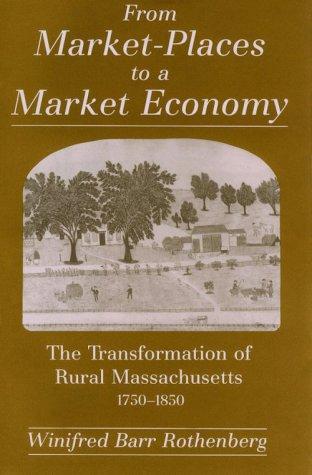
We note briefly that the premise of Rothenberg's thesis clearly depends on the widespread prevalence of local regulatory regimes of both product and labor markets in the 18th century, particularly the early 18th century (given that her observation of increasing market integration begins around 1750). To support that thesis, she draws primarily on quantitative data. Further qualitative support is found in the so-called "Whig" historiography of the American Revolution, of which the quintessential proponent is Gordon Wood's Radicalism of the American Revolution (1992).
For Wood, the American Revolution was radical in its assertion of a popular basis for politics. For Joyce Appleby, a scholar writing along similar lines, its importance for political economy was in its emphasis on liberalism as an economic philosophy -- stressing private property rights, enforceable contract, economic independence, and a laissez-faire theory of government policy. A corollary of this thesis is the rise of a free market mentalitie, as Rothenberg put it -- a rise in the value of free markets and trade for mutual gain among the newly democratic society. Rothenberg finds quantitative evidence of this assertion in the regional convergence of market prices for various agricultural goods as well as the rise of contract labor in the Northeast in the late-18th and early-19th centuries. Her analysis draws from account books, diaries, and prices taken from newspapers. A key aspect of her thesis is the rise of free contract labor and free labor more generally, as distinct from the coercive institutions of the early 18th century. The question to be answered there is, Did the American Revolution give rise to what we would eventually see as the "free labor" necessary to fuel the fire of the Industrialization of the North? Rothenberg answers with a resounding "Yes". Others have their reservations.
Writing from a different perspective, Morton Horwitz's 1977 Transformation in American Law had a chapter on contract law which suggested (but did not prove) a counter-hypothesis. Sifting through court records and treatises he finds that not only was labor subject to a set of legal controls in the early 19th century significantly curtailing its freedom to contract and its mobility, but that the law exhibited a clear class bias against the worker and in favor of entrepreneurship. Taking issue with Horwitz's thesis in her own 25-year-later reconsideration (published on EH.net here) of Transformation she shows how many of the claims of class bias and worker unfreedom in Horwitz have not withstood more recent, closer examinations of the actual application (or more appropriately, lack thereof) of some of the seminal labor cases upon which Horwitz relies. (See Karsten's Head versus Heart for a good summary of right-to-quit law in the Northeast.)
| Time to put race at the center of labor history in the U.S. instead of unfree white labor? |
In the next part of the series, we will see how recent historical research has questioned precisely the points mentioned in the previous paragraph, seriously calling into question whether labor developed along an essentially government-free trajectory in the early Republic.
Saturday, January 7, 2012
law, labor, and capitalism syllabus
 |
| American shoemakers in the late-18th century. Image source: http://griid.org/2011/03/01/march-1-creation -of-the-first-union-with-a-closed-shop-agreement-in-the-u-s/ |
I steered the course at various points more towards social and political history than what might be seen as standard for a legal studies course. I did this for two reasons.
- The course is directed at juniors and I had trouble finding "digestible" material on labor law history for students who do not have a strong background in legal concepts.
- A study of social protests and political consciousness of labor can give a valuable perspective into the particular issues workers had with the law as well as how they sought to amend their position. Sometimes, legal history gets wrapped up in the evolution of rules and norms that have little to no impact on how social conflict is instigated or resolved through the law. My course represents an attempt to bring law and labor closer to each other.
Here is a good resource for constructing a legal history syllabus.
Thursday, December 29, 2011
economic historians on the job market, 2011-2012
The start of a continuing series.
A brief look at a few of the top mainstream departments (Harvard, Berkeley, Chicago...) does not reveal much in the way of budding economic historians (... I guess I shouldn't be surprised. Check back soon for more interesting candidates). However, one of Daron Acemoglu's students is working on some interesting projects related to political economic history: his name is Pablo Querubin. His job market paper is an econometric study of rent-seeking by U.S. politicians in the second half of the 19th century. Abstract and other papers (some of which are also on economic history) here.
The story according to mainstream economists is as follows. Politicians are assumed to be self-interested profit maximizers who seek to gain from the system by acting on their own interests -- interests which do not necessarily line up with the interests of their constituents. The amount of this rent-seeking behavior, furthermore, is strongly related to the accountability of the underlying political system (how fair the electoral system is and so on). In short, a democratic government such as what we have in the U.S. would probably have relatively fewer rent-seeking politicians than a despotic one would.
Now, if we consider the second half of the 19th century-United States, "democratic" usually isn't the first word that comes to mind. Nevertheless, the question is, what would we expect given the postbellum United States? Was there significant rent-seeking? How would you test for it? Querubin uses a methodology which allows him to test whether politicians who were elected by a close margin saw their incomes increase more than the losers of that close electiono over the course of the rest of their careers.
He finds that this was not the case for politicians who were elected in the 1870s, but that it was the case during the Civil War. He interprets this finding as suggesting that in periods when a democracy is in some kind of (political or economic or both) crisis, the space is opened for rent-seeking. Otherwise, a democracy like the U.S. operates pretty well at insulating against such behavior. This is further supported by evidence that a team headed by Acemoglu found recently supporting the idea that "financial firms connected to Timothy Geithner experience an abnormal return of 15% after his nomination as Treasury Secretary," which, since it took place during the financial crisis, qualifies in his story. Although it really doesn't, since Geithner is just one person and I'm not sure that the other contenders for the Treasury Secretary position are necessarily doing any better or worse than him (which would be the true test of the hypothesis).
But should we be surprised that in a capitalist democracy we find such results as Querubin's? Politicians already occupy certain class positions before they gain power, suggesting that if there is some disturbance to democracy, it occurs before anyone approaches the ballot box. If you're looking for a malfunctioning democracy, rent-seeking behavior is not necessarily the first place you would look. I suggest you look instead at the politics of the capitalist state itself: why didn't we see a full democratization of the south after the Civil War (indeed, the period under which Querubin finds no rent-seeking!), for example? The story that we usually find is that different groups of elites are fighting over public policy, often ignorant of the mass of workers, poor people, women and blacks below. It's not rent-seeking, but it is politics from a privileged position in the economic system.
In summary, Querubin's paper seems to present solid evidence against the public choice thesis that politicians are rent-seekers. And he seems to have some good things to say about our political system in the end -- we have a fair amount of checks in our electoral system to counterbalance any self-interested behavior by politicians. But it's only 2 cheers for democracy. Capitalist democracy may not produce rent-seeking politicians but it certainly does produce a situation in which not everyone has equal say in designing the "rules of the economic game".
A brief look at a few of the top mainstream departments (Harvard, Berkeley, Chicago...) does not reveal much in the way of budding economic historians (... I guess I shouldn't be surprised. Check back soon for more interesting candidates). However, one of Daron Acemoglu's students is working on some interesting projects related to political economic history: his name is Pablo Querubin. His job market paper is an econometric study of rent-seeking by U.S. politicians in the second half of the 19th century. Abstract and other papers (some of which are also on economic history) here.
The story according to mainstream economists is as follows. Politicians are assumed to be self-interested profit maximizers who seek to gain from the system by acting on their own interests -- interests which do not necessarily line up with the interests of their constituents. The amount of this rent-seeking behavior, furthermore, is strongly related to the accountability of the underlying political system (how fair the electoral system is and so on). In short, a democratic government such as what we have in the U.S. would probably have relatively fewer rent-seeking politicians than a despotic one would.
Now, if we consider the second half of the 19th century-United States, "democratic" usually isn't the first word that comes to mind. Nevertheless, the question is, what would we expect given the postbellum United States? Was there significant rent-seeking? How would you test for it? Querubin uses a methodology which allows him to test whether politicians who were elected by a close margin saw their incomes increase more than the losers of that close electiono over the course of the rest of their careers.

He finds that this was not the case for politicians who were elected in the 1870s, but that it was the case during the Civil War. He interprets this finding as suggesting that in periods when a democracy is in some kind of (political or economic or both) crisis, the space is opened for rent-seeking. Otherwise, a democracy like the U.S. operates pretty well at insulating against such behavior. This is further supported by evidence that a team headed by Acemoglu found recently supporting the idea that "financial firms connected to Timothy Geithner experience an abnormal return of 15% after his nomination as Treasury Secretary," which, since it took place during the financial crisis, qualifies in his story. Although it really doesn't, since Geithner is just one person and I'm not sure that the other contenders for the Treasury Secretary position are necessarily doing any better or worse than him (which would be the true test of the hypothesis).
But should we be surprised that in a capitalist democracy we find such results as Querubin's? Politicians already occupy certain class positions before they gain power, suggesting that if there is some disturbance to democracy, it occurs before anyone approaches the ballot box. If you're looking for a malfunctioning democracy, rent-seeking behavior is not necessarily the first place you would look. I suggest you look instead at the politics of the capitalist state itself: why didn't we see a full democratization of the south after the Civil War (indeed, the period under which Querubin finds no rent-seeking!), for example? The story that we usually find is that different groups of elites are fighting over public policy, often ignorant of the mass of workers, poor people, women and blacks below. It's not rent-seeking, but it is politics from a privileged position in the economic system.
In summary, Querubin's paper seems to present solid evidence against the public choice thesis that politicians are rent-seekers. And he seems to have some good things to say about our political system in the end -- we have a fair amount of checks in our electoral system to counterbalance any self-interested behavior by politicians. But it's only 2 cheers for democracy. Capitalist democracy may not produce rent-seeking politicians but it certainly does produce a situation in which not everyone has equal say in designing the "rules of the economic game".
Sunday, December 11, 2011
quote of the day: legal consciousness in early america
We don't often get to see how laws developed in and around courts (in legal treatises and reporters) trickle down to affect actual working people in the early 19th century. Much rarer to find such evidence in newspapers. But here is a gem, “From the Witness,” The Sun (Pittsfield, MA), 6 Sept. 1806:
Poring over this old piece, its arguments strike the reader of the common “few against the many” polemics that have found their place the historiography of post-Revolutionary society. Still, there is much more to the writer’s discussion than simply an attack on the “privileged”. The idea of the “few against the many,” alive today in popular media with discussions of who exactly constitutes the "99%", was used in post-Revolutionary America to criticize those who owned property, and therefore held status, without the necessary hard work to earn it. In the above, however, there is hard work: there is “industry and improvement,” and yet something still disturbs this social commentator about the nature of the legal system – one that has feudal remnants but continues to affect those in republican America. And are the claims of this farmer baseless or can we find evidence of them in the common law? The following suggests answers
The law of waste as it applied to inheritance changed over the course of the late eighteenth to early nineteenth century. The American legal understanding of waste is that it is any action which causes “permanent harm to real property committed by a tenant” (Black’s Law, 2009), though it could simply mean productive investment in the land by the tenant, as was the 18th century English understanding of the term. The common law view of waste as applied to inheritance developed over time to hold that one could not receive unproductive lands in inheritance, because that land had no inherent value. The economic logic behind the "instrumental conception” of the law was that the market for land knew best, especially in the early nineteenth century, so that a dower in unimproved lands would constrain the future productive value of the land. Indeed, this is the only way to explain the court's (contradictory!) claim that women themselves could not, after inheritance, make the land productive, because that would constitute waste! Horwitz goes so far as to suggest that these irrational decisions suggest that the judges’ goal in this thread of case law was to “undermine the right of dower itself.” For a discussion of the issue, see Horwitz, Transformation of American Law, pp. 56-58.
I walked near a snug farm house -- everything around wore the aspect of industry and improvement. I saw the aged inhabitant and his family departing from their dwelling -- I saw them turn and take a farewell view, and march away in silent sorrow. This property had been bequeathed to him by an affectionate wife, now deceased. He had sold his other property and laid out the avails in the improvement of this favorite spot, on which he wished to close his eyes. The common law of a foreign country, the odious remnant of a barbarous feudal system had dispossessed him of this, and turned him and his children, houseless and destitute, upon the world.
Poring over this old piece, its arguments strike the reader of the common “few against the many” polemics that have found their place the historiography of post-Revolutionary society. Still, there is much more to the writer’s discussion than simply an attack on the “privileged”. The idea of the “few against the many,” alive today in popular media with discussions of who exactly constitutes the "99%", was used in post-Revolutionary America to criticize those who owned property, and therefore held status, without the necessary hard work to earn it. In the above, however, there is hard work: there is “industry and improvement,” and yet something still disturbs this social commentator about the nature of the legal system – one that has feudal remnants but continues to affect those in republican America. And are the claims of this farmer baseless or can we find evidence of them in the common law? The following suggests answers
The law of waste as it applied to inheritance changed over the course of the late eighteenth to early nineteenth century. The American legal understanding of waste is that it is any action which causes “permanent harm to real property committed by a tenant” (Black’s Law, 2009), though it could simply mean productive investment in the land by the tenant, as was the 18th century English understanding of the term. The common law view of waste as applied to inheritance developed over time to hold that one could not receive unproductive lands in inheritance, because that land had no inherent value. The economic logic behind the "instrumental conception” of the law was that the market for land knew best, especially in the early nineteenth century, so that a dower in unimproved lands would constrain the future productive value of the land. Indeed, this is the only way to explain the court's (contradictory!) claim that women themselves could not, after inheritance, make the land productive, because that would constitute waste! Horwitz goes so far as to suggest that these irrational decisions suggest that the judges’ goal in this thread of case law was to “undermine the right of dower itself.” For a discussion of the issue, see Horwitz, Transformation of American Law, pp. 56-58.
Wednesday, December 7, 2011
legal standard of the day -- when could workers recover wages in 1840s pennsylvania
The ruling here established the fact that "faithful service" is an agreement implicit in the employment contract. That is to say, if a worker "misbehaves" on the job, he is not legally entitled to any back pay (e.g., if he misbehaves on the 29th of the month and the employer fires him promptly and wages for the month are due to him on the 30th, he gets nothing). From Libhart v. Wood (PA, 1841) argued before the Supreme Court of Pennsylvania:
When a servant, who has engaged for a certain time at certain wages, is turned away by his master before the period for which he has engaged to serve has expired, and his dismissal be in consequence of his own misconduct, he will be entitled to no wages; for his faithful service is a condition precedent to his right to wages, and that condition, in the case supposed, he has not performed. But if his dismissal be unjust, the master can not, by his wrongful discharge, prevent the servant from recovering a compensation for his services. Thus the law carefully protects the rights of both master and servant.
Thursday, December 1, 2011
quote of the day: law and labor in early america
Law hung old women in Salem because it was proved, said the courts of law, that they were witches. Law hung the Quakers in Boston, because they wore strait coats and broad brimmed hats. Law whipped the members of the same sect, at the cart tail, from town to town in New Hampshire. Law bared the backs of the Baptists in Boston, and lashed them until the skin was flayed off, because they said 'every man has a right to worship God according to the dictates of his own conscience;' and law in Connecticut compelled every body to cut their hair in a particular manner and prosecuted men for kissing their wives on the first day of the week. Law laid the stamp tax, and the tea tax, and our fathers resisted those unjust laws even unto blood.... Must we be told to submit in silence to law, merely because it is law, without reference to its constituent principles? No law will ever command the respect of any, not even a slave in every sense, unless that law is just.From An Address delivered before the Mechanics and Working-Men of the City of Brooklyn, on the Celebration of the Sixtieth Anniversary of American Independence (1836) by Seth Luther, quoted in Tomlins, Law, Labor, and Ideology in Early America.
Monday, November 7, 2011
tomlins and uci law - changes in the air
Christopher Tomlins, who recently left his position at the American Bar Association to join the faculty at the newly created UC Irvine law school, is taking some important steps there toward making the study of law more interdisciplinary:
http://www.uci.edu/features/2011/11/feature_interdisciplinary_111107.php
A good quote from the article:
Tomlins, who is currently one of the most influential researchers of colonial and early American legal history, recently finished a mammoth book on law, labor and the shaping of civic identity in early America entitled Freedom Bound. It came out in 2010 via Cambridge Press and it is a masterpiece.
Even though Tomlins' work is still essentially legal history, where the evolutionary mechanisms behind rules takes center-stage, some of his latter works have dipped into the intersections of law and the literary mind (including research into the works of Walter Benjamin) and his overall approach to the law is basically Althusserian -- that is, studying the internal mechanisms of law as relatively autonomous from a materialist (feudal/capitalist) base. He is truly an excellent match for taking on such an interesting task at UCI.
http://www.uci.edu/features/2011/11/feature_interdisciplinary_111107.php
A good quote from the article:
[Tomlins] plans to have common colloquia, luncheon workshops, social functions and retreats so that students and faculty from different disciplines can swap perspectives.
“It will create a sense of interdisciplinary community and tie the law school into the rest of the campus,” Tomlins says. “Irvine is an especially appropriate place for such a program because there’s already an unusually large concentration of faculty outside the law school doing law-related work.”
The Program in Law & Graduate Studies, he says, is ideal for students interested in professional or academic careers involving law and legal institutions, policy analysis or applied research in law-related fields. These include criminal justice and criminology, urban planning and environmental issues, discrimination, human rights and intellectual property.
Tomlins, who is currently one of the most influential researchers of colonial and early American legal history, recently finished a mammoth book on law, labor and the shaping of civic identity in early America entitled Freedom Bound. It came out in 2010 via Cambridge Press and it is a masterpiece.
Even though Tomlins' work is still essentially legal history, where the evolutionary mechanisms behind rules takes center-stage, some of his latter works have dipped into the intersections of law and the literary mind (including research into the works of Walter Benjamin) and his overall approach to the law is basically Althusserian -- that is, studying the internal mechanisms of law as relatively autonomous from a materialist (feudal/capitalist) base. He is truly an excellent match for taking on such an interesting task at UCI.
Tuesday, November 1, 2011
thought/quote of the day: english law and trade in late-18th century africa
From the Wikipedia article on tortious inference:
In a similar case, Tarleton v. McGawley, 170 Eng. Rep. 153 (K.B. 1793), the defendant shot from its ship Othello off the coast of Africa upon natives while “contriving and maliciously intending to hinder and deter the natives from trading with” plaintiff’s rival trading ship Bannister. This action caused the natives (plaintiff’s prospective customers) to flee the scene, depriving the plaintiff of their potential business. The King's Bench court held the conduct actionable. The defendant claimed, by way of justification, that the local native ruler had given [defendant] an exclusive franchise to trade with his subjects, but the court rejected this defense.
Sunday, October 23, 2011
quote of the day: lawyers and justice in colonial vermont
On attitudes toward the law in colonial Vermont and New Hampshire:
And yet, popular opinion of lawyers is sour. There seems, in the end, to be a kernel of this conservatism in our modern discourse still left over from our distant past.
Although, it is useful to remember at this point that there is a third way, definitely distinct from the two above -- more revolutionary in scope. Abolish the institutions of capitalism which give rise to a professional class of lawyers, and maybe the path to justice, obfuscated by the lawyer (according to the quote above!), might end up being a bit clearer.
The Yankee pioneers, and especially the judges, who were invariably laymen, viewed trained lawyers with suspicion. One lawyer complained that a chief justice in New Hampshire, 'having no law learning himself, did not like to be pestered with it at his courts.' Another lawyer attempted to file a demurrer, only to have it ridiculed by the judge as 'an invention of the Bar to prevent justice.' (John Page, "The Economic Structure of Society in Revolutionary Bennington", Vermont History 49 [1981], pp. 69-84)You really have to wonder how much such attitudes have changed over time, or where this view is found in the general population today. Most of us have heard jokes about lawyers and their uselessness to society. But, what other way would we have it? Do we really want to go back to the mid-18th century when a single judge, member of some privileged elite, would argue and then decide on our cases instead of some weasel-of-a-lawyer? Aren't things made just a tiny-bit better by such improvements?
And yet, popular opinion of lawyers is sour. There seems, in the end, to be a kernel of this conservatism in our modern discourse still left over from our distant past.
Although, it is useful to remember at this point that there is a third way, definitely distinct from the two above -- more revolutionary in scope. Abolish the institutions of capitalism which give rise to a professional class of lawyers, and maybe the path to justice, obfuscated by the lawyer (according to the quote above!), might end up being a bit clearer.
Monday, October 17, 2011
link roundup
Been reading too much lately. Here is a menu of select links for your enjoyment:
History of the Rhode Island Supreme Court highlights the interaction between economic growth, distribution, and institutional change. I enjoyed the discussion of how the rise of the textile towns led (or did not lead to) changes in political representation in the state.
Glenn Gould wikipedia entry. One of the new graduate students in our department (hi Luke!) knows too much about non-economics stuff and has recently introduced me to Gould's academic writings on art. Gould has done some amazing interpretations of classical pieces including two very striking renditions of Bach's Goldberg Variations. Start listening to the 1955 version here. 1981 version here. Gould felt that the best strategy for classical player is to come up with completely new and innovative interpretations of existing pieces, not necessarily striving for what the composer may or may not have intended (who could really know that?) but instead trying to make something that is internally consistent and sounds beautiful.
A truly excellent Lapham's Quarterly history of financial speculation. The story they tell is how financial speculation is a tale of how we as humans fall in love with our ideas and creations but in the end how we're fallible. Some really remarkable quotes in a well-written piece. Here's one that comes at the end of the article: Speaking about the technologies that in part drove the financial boom and eventual bust:
There has been way, way too much aimless debate over Corey Robin's book The Reactionary Mind. To the point of pure frustration of people like me, who understand exactly where Robin is coming from. While engaging in the debates somewhat peripherally over at Rortybomb, I began to realize that people just don't understand the terms in which a classical conservative would make his or her point. Liberals are either too elitist to think that conservatives could be making an intellectual argument (though it's hard to blame them on that front), or their minds are too ingrained into a narrow view of politics that sees the "Republican-Democrat" division as the universal axis of all politics. let's get something straight: classical conservatives understand power and politics and class much better than any progressive Apple-loving Obama-revering hippie. It's not their fault that conservatives live in a different world. No, I take that back -- it is their fault, and that's part of the reason why America is in such a bad shape today. In short, Robin is the only one who really makes sense of modern politics and it's too bad that mainstream liberals can't own up to that fact.
The Chronicle of Higher Education exposes some of the intellectual roots of the beautiful movement that is #OWS.
History of the Rhode Island Supreme Court highlights the interaction between economic growth, distribution, and institutional change. I enjoyed the discussion of how the rise of the textile towns led (or did not lead to) changes in political representation in the state.
Glenn Gould wikipedia entry. One of the new graduate students in our department (hi Luke!) knows too much about non-economics stuff and has recently introduced me to Gould's academic writings on art. Gould has done some amazing interpretations of classical pieces including two very striking renditions of Bach's Goldberg Variations. Start listening to the 1955 version here. 1981 version here. Gould felt that the best strategy for classical player is to come up with completely new and innovative interpretations of existing pieces, not necessarily striving for what the composer may or may not have intended (who could really know that?) but instead trying to make something that is internally consistent and sounds beautiful.
A truly excellent Lapham's Quarterly history of financial speculation. The story they tell is how financial speculation is a tale of how we as humans fall in love with our ideas and creations but in the end how we're fallible. Some really remarkable quotes in a well-written piece. Here's one that comes at the end of the article: Speaking about the technologies that in part drove the financial boom and eventual bust:
Nearly fifty years ago, Marshall McLuhan wrote about our tendency to become fascinated by our inventions, which are, ultimately, extensions of ourselves. As McLuhan tells it, the death of Narcissus had to do not only with his reflection but with his inability to see himself in it. Just as the words “narcosis” and “narcotics” derive from his name, Narcissus was numb; he treated his image as an object of courtship, and he willingly became its slave. McLuhan, ever alert to the perverse urge to lose our uncomfortable selves, described how Narcissus died so that we could live. We court an exquisite ruin whenever we succumb to a pretty face that we fail to recognize as our own.Somewhat of an "oldie", this article from Daron Acemoglu outlines (in an extremely broad sense of the word "outline") the tasks of institutional economics as economic theorists move forward. As some of you may know, Acemoglu has been a real leader in this field and his works are absolutely recommended (though maybe, you can skip some of the math!). If you want to see where some of his work is headed, check out page 23 of his Political Economy Lecture Notes, "Towards a Framework".
There has been way, way too much aimless debate over Corey Robin's book The Reactionary Mind. To the point of pure frustration of people like me, who understand exactly where Robin is coming from. While engaging in the debates somewhat peripherally over at Rortybomb, I began to realize that people just don't understand the terms in which a classical conservative would make his or her point. Liberals are either too elitist to think that conservatives could be making an intellectual argument (though it's hard to blame them on that front), or their minds are too ingrained into a narrow view of politics that sees the "Republican-Democrat" division as the universal axis of all politics. let's get something straight: classical conservatives understand power and politics and class much better than any progressive Apple-loving Obama-revering hippie. It's not their fault that conservatives live in a different world. No, I take that back -- it is their fault, and that's part of the reason why America is in such a bad shape today. In short, Robin is the only one who really makes sense of modern politics and it's too bad that mainstream liberals can't own up to that fact.
The Chronicle of Higher Education exposes some of the intellectual roots of the beautiful movement that is #OWS.
Thursday, February 17, 2011
gathering potential quotes for the afit conference
Freedom is neither a legal invention nor a philosophical conquest, the cherished possession of civilizations more valid than others because they alone have been able to create or preserve it. It is the outcome of an objective relationship between the individual and the space he occupies, between the consumer and the resources at his disposal.
Claude Levi-Strauss
Tuesday, November 2, 2010
quote of the day, tomlins part MLXII
Another great excerpt from an excellent scholar:
Though unquestionably an important source of early colonial-era labor power, migrant indentured servitude was nevertheless considerably less significant in establishing a foundational character for the performance of work in the colonial era than has been assumed. Participation in the performance of work was widespread in the population as a whole -- virtually everyone worked in some capacity -- and the institutional structure of performance far more diverse. Correspondingly, the companion assumption that the American political economy followed a clear trajectory from ubiquitous 'unfreedom' toward a late eighteenth and nineteenth-century 'free' waged workforce norm (market driven allocation of individual capacities to labor through unregulated wage contracts) also becomes suspect, or at the very least vastly more complicated than prevailing analyses have supposed.
From Christopher Tomlins, Freedom Bound: Law, Labor, and Civic Identity in Colonizing English America, 1580-1865 (Cambridge, 2010)
Monday, November 1, 2010
are property and contract efficient?
Anastasia writes in the comments of this post:
Isn't that sort of contradictory that the same neoliberal or libertarian thought-path would lead to a legal structure that hinders its own model to efficiently operate? Is this an example of the inefficiency of the legal system itself, as you explained, especially in that it is a "passive" institution in this case. Maybe I read into this wrong?
[By the way, the point about "passive institutions" is something of my own invention. I tend to see two competing views of institutions which either treat property rights and other parts of the law as passive (in the sense that the economic agents involved simply respond to, say, carrots or sticks on the playing field) or active (in the sense that economic agents can actually be "pushed" by an institution in some way or another toward a path which they would not otherwise have gone in the absence of a change in that institution).]
At any rate, yes, I would agree that it is contradictory to the neoliberal model of, say, development which emphasizes the establishment of, e.g., secure private property rights and sound financial infrastructure as key elements to successful growth paths. I don't really know what to say to that, except that I agree. Does anyone else have any thoughts?
As I see it, one can go about developing a critique to the neoliberal worldview as contradicatory through two ways.
1. You adopt the trend which Horwitz does for the U.S. case, which is to show how states were necessary to capitalism's success everywhere and at every time. People should check out the work of Ha Joon Chang as an accessible introduction to this idea in support of the late developers such as S. Korea. Another good book here is Alice Amsden's Asia's Next Giant.
2. You adopt a more theoretical route, which is the path taken by people like Duncan Kennedy. On this route, you demonstrate the inconsistency of common neoliberal assertions, either by pointing out theoretical cases which are not covered by the model or you introduce some empirical inconsistencies with the theory. Kennedy has a great paper with Frank Michelman which addresses the theoretical problems with libertarian views titled "Are Property and Contract Efficient?" It's a really interesting critique of the law and economics movement from the perspective of CLS. Here is a link to the paper.
It's a tough paper so if anyone wants to see my notes on it feel free to email me. Here is a small summary that gives a flavor of their approach:
The authors use a unique methodology for analyzing the efficiency of systems of private property and enforceable contract. They identify the system, say private property (hereafter denoted PP, to stay consistent with the article). They then introduce two alternative systems: state of nature (SON) and forced sharing for needs (FSN). The former is simply a system with no enforceable private property, while the latter is characterized by rules similar to PP (i.e., enforceable private property in most dimensions except for one) but where ownership takes on an additional qualification: if someone “needs” something someone else owns (in order to stay alive), there can be state-enforced taking. The authors’ goal is to compare the variable “hours of work” across systems and see which systems maximize this variable under five different arguments popularly used in support of the PP regime.
The authors identify five arguments for PP: 1. security increases production; 2. theft is inefficient; 3. PP reduces uncertainty; 4. Coordinational Failure; 5. Distribution of the tradeoff between work and leisure. We will briefly sketch a one of these arguments in how they study the variable “hours of work” in the regime of PP vs. the alternative system of SON.
On (1), that security of property increases production. The standard argument is that the security which enforcement of property affords leads to greater incentives to work, increasing the maximal number of work hours. However, the authors argue that this is merely an empirical assertion: people may work more hours under the SON since the chance of theft is higher here, so they have to take account of this risk when supplying effort. However, one in support of PP may then argue that (5) this alters the distribution of the tradeoff between work and leisure, since people would work more but at the expense of less leisure and therefore efficiency is reduced in the SON. However, the authors argue that these same issues of efficiency over distortion of the tradeoff between work and leisure hold in PP. For example, consider a Crusoe economy where an individual chooses the optimal amount of work time given his preferences. Now, expand this model to imagine a multiple-Crusoe economy where each owns his own island. If one island is wiped out by a storm, the Crusoe on that island must work for another Crusoe in a kind of employer-worker relationship. Thus, for a specific amount of time each day, the unfortunate Crusoe is forced to work for another Crusoe just to be able to reproduce himself. This is time out of the unfortunate Crusoe’s day which cannot be devoted to a labor-leisure tradeoff on his own island and so the distribution of time between labor and leisure is distorted under PP as well.
Tuesday, October 26, 2010
703 10-27
The "old" labor law history around the turn of the century was conservative in the sense that it focused solely on the operation of the institutions -- law, the state, and so on. Thus these works were generally seen as reformist -- they focused on the "successes of the New Deal" and other ways in which workers were able to advance their economic power over employers. Even somewhat radical scholars in this "old" tradition, such as Edwin Witte's work on labor injuctions, was focused, in the end, on how to reform legislation so that the court decisions were more favorable to workers.
In particular, take the classic example of conspiracy law. At the turn of the century, unliked Britain, conspiracy law (the law of labor unions) still held that unions were illegal. This was maintained up until the New Deal when the NLRB was established. Witte, arguing in the 1920s, observed that over the latter part of the nineteenth century court injunctions were increasingly used against striking workers instead of holding full criminal trials. In fact, (I believe this is something noted in DuBois' Black Reconstruction though I'm not sure) the 14th amendment was more commonly applied to businesses during this time period than to blacks for racial crimes.
At any rate, the focus of this older tradition was on reforming law to give workers and unions a broader space for collective bargaining. Concentration was focused on the internal evolution of unions, law, and other institutions.
Interestingly, and I can't understand why this is the case, but there is another similarity among these early institutionalists (including Commons). They focused mainly on the postbellum period -- and in particular, on the 1870s and 1880s -- as crucial turning points in American capitalism. Forbath for example, while part of the "new" labor law history, also focuses on the postbellum period as central for understanding important debates in American economic history, including American Exceptionalism (he also uses many of the same themes as the old labor historians, including the issue of injunctions). I call attention to this fact because the social historians of the 1960s and 1970s, we will see, are much more interested (and rightly so, I think!) on antebelllum developments in political economy.
This was the older "camp". The "new" labor history was in part influenced by the social historians, but it is also more generally a product of the rise of leftists in academia in the 1960s and 1970s. In terms of the work of the social historians, the "new" labor history was inspired by Christopher Hill, David Montgomery, Herbert Gutman, and others. These social historians were all interested in the economic and cultural causes and effects of capitalism, to varying degrees. (Some of the names associated with social history which I mentioned last time are also important here.) Thus, part of the project of the new labor law historians was to find either a solid framework in which to discuss law and society, or to simply integrate some of the sources of data used by social historians into their analysis. As I mentioned on Monday, some did have explicit theoretical models, and the influence of the Marxian tradition in academia aided this trend.
Of course, the question is not simply to tie the two together. The more general point is the law's social-historical importance both theoretically and with respect to particular time periods and places. People are still debating the social-historical importance of the state. And when constructing our own ideas, we have to be careful, of course, of the extreme opposite of the new institutionalists -- i.e., we cannot simply assert that market or agent behavior is epiphenomenal to the law! the best labor law histories are therefore very clear about the place of the law in history, and try to tell stories which weave economic processes with political ones. But it is definitely much harder than it sounds. Even Christopher Tomlins -- one of the premier labor law historians of the past 20 years -- was criticized in his earlier work for focusing too much on rules and internal mechanisms of the law. Certainly they were Marxist-oriented conclusions and much more politically driven towards radicalism than the "old" labor law historians, but his research was still largely sterilized from underlying socioeconomic forces.
To appreciate the socio-historical relevance of the law, let's deal with an analytical problem which might get at a solution to this issue. Let's say we want to understand the "conditions of existence" of capitalism. The rise of capitalism involved the destruction of some of the aspects of the old system (stage 1: household ownership of the means of production, work primarily from the home, seasonal fluctuations in output, work for use instead of profit), as well as the creation and legitimation of new features: stage 2, capitalist social relations (wherein workers sell their labor in exchange for a profit), ownership of the means of production, a new organization of work. The processes at work in both arenas are, in turn, cultural, economic, nautral, and political in nature.
We have stage 1 and 2, with 4 aspects working between them.
To narrow down our thinking we're going to think of this transition in terms of the limiting factor of politics, and discuss in what ways keeping our foot on politics limits the transition between the two stages. In other words, let's think of some of the economic, natural, and cultural factors contributing to the evolution of stages.
Economically, the development of the power loom allowed employers to make cloth faster and in greater quantities than home production. This is an economic advantage of working in the firm. The power loom was essentially able to out-compete home production, leading to the general decay of home production. So, workers are left with much less to do in the home. Now, as long as workers don't leave their homes (say, for the west), you have a bunch of people at their home with nothing to really do. If the means of production are gone and they don't have any property, those are economic freedoms to leave. Consider the religion. If there are changes in the religious atmosphere, such as a cultural norm resistent to laziness, then there may be cultural freedoms to leave, as well -- religion spurs the productive spirit to leave the household. Or, the family relations are broken down. Natural freedoms are also created, since in the winter time, when there is little to do on the farm, freeing up some laborers to go to the new factory.
At any rate they join a factory and start to work. My point is that they were free economically, naturally, and culturally, to leave home. What could still be holding them back?
There are political freedoms to consider, since a variety of laws and political norms may entrench certain power interests with a vested interest in keeping workers home, such as feudal interests or (as with Steinfeld) indentured servitude's status in the law (if it were still legal, this would create a problem for employers who needed a free labor force).
The question is where do the political freedoms come from? And this is the first half of the story, the first stage, addressed by Steinfeld as well as many others. The question, simply put, is what kind of political justifications or reasons can we make for the freedom of workers to leave their homes for the factories? Part of Steinfeld's contribution to the story is that the political freedom is not all about rights, or political freedom. Rather, it's that such political freedom to leave the home is also contingent on law. And in fact, law actually mattered because law played a role in defining the freedom of the worker.
That's a pretty interesting idea. If the American Revolution wasn't this outburst of world-changing individualism (in the sense that while it may have been about individualism it didn't change everything else about institutions in the process), but rather that individualism instead needed also to be changed and accomodated by law, then we've added another part to the story.
We are also, at this point, confronted with a very important choice. Still in stage 1.
On one hand, we can assume radical individualism of the Revolution and then say the law still had to work out the legal status of political freedom. This is the path taken by Steinfeld.
On the other hand, we can assume some other significances of the Revolution and then ask what role the law played in freeing up the worker in that case. This is the path taken by Tomlins and some others. (Mostly Tomlins. He is a key figure in the new labor law history, having just finished a 600+ page tome on the history of labor and law in the U.S. from colonial times to the Civil War.) We probably won't get to it in this post, but it is a highly intriguing idea, especially with reference to the precise social-historical relevance of law to labor.
As I said, Steinfeld is focused on the first of these two points. In short, he argues that the American Revolution had an "ambiguous" impact on the development of free labor because law still needed to sort out what it meant to be "free" in an employment relationship, from the standpoint of Master-Servant law. The interaction between the two processes of law and work (i.e. the entrypoint for Steinfeld's discussion) is indentured servitude. [Interestingly, the role of indentured servitude has been called into question empirically by some later law and labor scholars. What are the implications?] Citizens increasingly believed that indentured servitude was too close to slavery and thus incompatible with the ideals of "possessive," or republican, individualism. Thus the case of Mary Clark is a turning point in the labor law because this is a woman of color who had the right, according to the courts, to both voluntarily enter into, and voluntarily serve, in a labor contract.
However, Steinfeld believes we have a slight problem, even with this groundbreaking result -- notice that Steinfeld keeps "free" in quotations precisely because the economic power of workers was still reduced in this process. In particular, in individuals' arguments for freedom based on notions of self-government (a political kind of freedom, borrowed from the Revolution's ideals of republican individualism) led to it being much harder for these individuals to argue for freedom based on the ownership of property. I.e., they had a political right to dispose of their persons as they saw fit, but the propertied notion of freedom was reduced to another sphere -- that of the economic sphere. It therefore became increasingly harder for workers to argue for freedom in the economic sphere -- i.e., their freedom vis-a-vis the work process (since they sold their labor power as property).
This particular process supposedly came about because journeymen and other laborers argued on the grounds that they should be treated as juridical equals in the employment contract, not on the grounds that they cannot be directly compelled by their masters (148). Nevertheless, this is something laborers (read: indentured servants...) apparently "achieved", and it is very important to realize this:
What was left to masters was 'persuasion.' Masters would no longer be entitled to rule, to use law directly to compel workers to do their wills. Instead, they would be limited to 'influencing' the decisions that workers were entitled freely to make for themselves, to structuring the 'incentives' workers faced. But it is important to be clear about the significance of this influence. Employers would continue to have power, derived from law, to control workers. Only now this power would take a different form: it would not be based on rights physically to coerce workers but would be based instead on rights masters had under property, contract, and labor law. These legal rights would constitute the basis for the economic pwoer they would continue to wield over wage workers. (148)
Another quote: "it comported with the emerging model of labor that left to the laborer the formal decision whether to stay or to go" (148).
At this point it is useful to step back and realize what has been accomplished. Steinfeld has theoretically fulfilled both criteria for understanding the transition to capitalist relations (i.e., stage 1 and stage 2). First, he explains very well the freeing up of certain forms of labor in the early nineteenth century. Unlike the historians of liberal democratic capitalism (take your pick: Wood, Appleby, Smith) which simply focused on individualism, Steinfeld adds an initial barrier but ends up with the same conclusions: a breaking down of the old model in exchange for the new one. The enemy is us.
In other words, the institutions were still liberal democratic in essence. That point is clearly made by Steinfeld, and we end the discussion of Steinfeld here (pg. 159):
One perhaps unintended consequence of the Revolution wsa that the hierarchical forms of traditional society began to meet with greater and greater resistance. Increasingly, ordinary working men and women refused to accept the formal hierarchical practices that had defined traditional master-servant relations, denouncing these as a slavery unsuited to liberty-loving Americans. Over a number of decades, a consensus emerged that traditional practices in the employment relationship violated the basic equality promised by the American Revolution.
What do you think -- did Steinfeld hit it on the mark or is something else going on here...?
Sunday, October 24, 2010
econ 703 topics, 10-25
The early 1960s saw the birth of the law and economics movement, the tenets of which are most famously represented by Ronald Coase's 1960 article on "The Problem of Social Cost" in the Journal of Law and Economics (that journal began in 1958 and is published by University of Chicago Press). From that article many have extracted the famous “Coase theorem” regarding the efficiency of private bargaining solutions to externality problems, in the absence of transactions costs and regardless of the initial distribution of property rights. Ronald Coase moved to the University of Chicago in 1964 and became editor of the Journal of Law and Economics there. In the 1970s the discipline generated more steam as Richard Posner published his Economic Analysis of the Law in 1973. (Posner moved to University of Chicago in 1969.) Law and economics was heavily influenced by libertarianism and many of its proponents argued for strict private property rights and enforceable contracts, as well as an overall market-oriented view of society.
One can see how this field made a strong impact in economics as well as law departments. The institutional world view encapsulated in law and economics perfectly captures the Walrasian model of microeconomic theory: general equilibrium, arising from enforceable and complete contracts, clear property rights, and perfectly competitive markets. One might say it was a match made in heaven.
Interestingly, just as discontents with the neoclassical model of economics led to certain contradictions in the field in the late 1960s and 1970s (look no further than our own department's radical history for evidence of that), a similar dialectics occurred in law, beginning in the late 1970s with the Critical Legal Studies movement (CLS). And on another point of similarity, CLS also began at Harvard. Influenced by post-structuralism, Frankfurt school critical theory, as well as social problems such as with race, CLS had its reactions against the law and economics school. (In fact, in the late 1980s when Obama was a law student at Harvard, the CLS scholars were constantly in heated debates with the law and economics group, all the while Elena Kagan, Supreme Court Justice, was dean of the school: source.)
In particular, CLS was fueled by some of law and economics' assertions. For example, CLS had an issue with the idea that that law must leave (or, in general, does leave) matters of distribution to the legislative branch. I.e., they contested the claim that property law was not distributional. Also, CLS took law and economics to task for its assertion that that law, in a liberal democracy, fosters Pareto efficiency through enforcing contracts, protecting property rights, thereby promoting private bargaining solutions to problems of externalities. On the first point, CLS (recall their Marxist influences) argued that law shows clear evidence of class bias and is therefore not distributionally neutral. They also showed that a social definition of property completely excludes the possibility of neutrality. On the second point, CLS argued that there are a multitude of real blockades to the efficient bargaining model that are more than simple perturbations from the standard Coasean or Walrasian bargaining model. Economic agents play by a fundamentally different kind of game than the one asserted by the law and economics school.
The CLS critique, like their brother radicals in economics, was both contemporary- and historically-oriented. Horwitz’ book, whether consciously or not (asked years later whether he thought Transformation was Marxist, he replied that he didn't think so), illustrates the relative autonomy thesis of Marxism in historical context. This thesis, advanced by Althusser and later expounded upon by Poulantzas, holds that in a base-superstructure framework, law is relatively autonomous from the economy to the extent that law serves no particular class, though does, in its reproducing of the existing order of social relations, promote the political position of capitalists. In other words, after the American Revolution, the courts began to make reasoned decisions that just so happened to aid the propertied class.
This is supported by the three-stage transition outlined in Transformation. We are familiar with the first two stages: the shift from law as custom to law as an instrument. Beginning in the early nineteenth century, judges consciously changed their views on the nature of the law: when defending their position in the cordwainers’ case of 1806 (denying workers the right to strike) they appealed to the law as “the will of the majority. It is law because it is their will – if it is law, there may be good reasons for it though we cannot find them out” (22). “Judges began to conceive of themselves as legislators,” Horwitz writes, in a thesis that highlights the judges’ reasons behind their decisions to consciously favor one economic group over another.
In other words, law has its own political mechanisms, but courts in this period became more conscious of their role as promoter of economic performance. They saw law as an instrument for economic growth, but they themselves were not instruments of a social class. They were the ones that changed their views and took on a more powerful role in American political economy – it was not a direct propertied influence from a new class of merchants and entrepreneurs in the sense of, say, Ralph Miliband’s view of British politics in modern capitalist society.
If it seems like we have strayed a bit too far from law and economics at this point, that is because we have! The CLS arguments are so radically different from the view of the law as a distributionally neutral institution which promotes efficient bargaining. In the language of political economy, Horwitz is an institutionalist because he refuses to see the law as epiphenomenal to market activity. He believes, to the contrary, that our "present conceptions of the rule of law" rest on a "Hobbesian vision of the state and human nature," so that the law essentially vindicates the "adversarial, competitive, atomistic conception of human relations" (565).
One can see how this field made a strong impact in economics as well as law departments. The institutional world view encapsulated in law and economics perfectly captures the Walrasian model of microeconomic theory: general equilibrium, arising from enforceable and complete contracts, clear property rights, and perfectly competitive markets. One might say it was a match made in heaven.
Interestingly, just as discontents with the neoclassical model of economics led to certain contradictions in the field in the late 1960s and 1970s (look no further than our own department's radical history for evidence of that), a similar dialectics occurred in law, beginning in the late 1970s with the Critical Legal Studies movement (CLS). And on another point of similarity, CLS also began at Harvard. Influenced by post-structuralism, Frankfurt school critical theory, as well as social problems such as with race, CLS had its reactions against the law and economics school. (In fact, in the late 1980s when Obama was a law student at Harvard, the CLS scholars were constantly in heated debates with the law and economics group, all the while Elena Kagan, Supreme Court Justice, was dean of the school: source.)
In particular, CLS was fueled by some of law and economics' assertions. For example, CLS had an issue with the idea that that law must leave (or, in general, does leave) matters of distribution to the legislative branch. I.e., they contested the claim that property law was not distributional. Also, CLS took law and economics to task for its assertion that that law, in a liberal democracy, fosters Pareto efficiency through enforcing contracts, protecting property rights, thereby promoting private bargaining solutions to problems of externalities. On the first point, CLS (recall their Marxist influences) argued that law shows clear evidence of class bias and is therefore not distributionally neutral. They also showed that a social definition of property completely excludes the possibility of neutrality. On the second point, CLS argued that there are a multitude of real blockades to the efficient bargaining model that are more than simple perturbations from the standard Coasean or Walrasian bargaining model. Economic agents play by a fundamentally different kind of game than the one asserted by the law and economics school.
The CLS critique, like their brother radicals in economics, was both contemporary- and historically-oriented. Horwitz’ book, whether consciously or not (asked years later whether he thought Transformation was Marxist, he replied that he didn't think so), illustrates the relative autonomy thesis of Marxism in historical context. This thesis, advanced by Althusser and later expounded upon by Poulantzas, holds that in a base-superstructure framework, law is relatively autonomous from the economy to the extent that law serves no particular class, though does, in its reproducing of the existing order of social relations, promote the political position of capitalists. In other words, after the American Revolution, the courts began to make reasoned decisions that just so happened to aid the propertied class.
This is supported by the three-stage transition outlined in Transformation. We are familiar with the first two stages: the shift from law as custom to law as an instrument. Beginning in the early nineteenth century, judges consciously changed their views on the nature of the law: when defending their position in the cordwainers’ case of 1806 (denying workers the right to strike) they appealed to the law as “the will of the majority. It is law because it is their will – if it is law, there may be good reasons for it though we cannot find them out” (22). “Judges began to conceive of themselves as legislators,” Horwitz writes, in a thesis that highlights the judges’ reasons behind their decisions to consciously favor one economic group over another.
In other words, law has its own political mechanisms, but courts in this period became more conscious of their role as promoter of economic performance. They saw law as an instrument for economic growth, but they themselves were not instruments of a social class. They were the ones that changed their views and took on a more powerful role in American political economy – it was not a direct propertied influence from a new class of merchants and entrepreneurs in the sense of, say, Ralph Miliband’s view of British politics in modern capitalist society.
If it seems like we have strayed a bit too far from law and economics at this point, that is because we have! The CLS arguments are so radically different from the view of the law as a distributionally neutral institution which promotes efficient bargaining. In the language of political economy, Horwitz is an institutionalist because he refuses to see the law as epiphenomenal to market activity. He believes, to the contrary, that our "present conceptions of the rule of law" rest on a "Hobbesian vision of the state and human nature," so that the law essentially vindicates the "adversarial, competitive, atomistic conception of human relations" (565).
Why should economists care? How can we operationalize, or make use of, Horwitz’ insights concerning the law? Consider this quote, again from 1977: "a recent interpretation of Marx's political theory [by Avineri] ... has demonstrated that Marx himself consistently asserted a regular interaction between 'substructure' and 'superstructure' through which thought, values, and social arrangements actually do affect consciousness and, ultimately, history" (563). In other words, while it is true that economy constitutes law, law also constitutes economy.
This is the central point of Friedman’s view of law and society – society makes property, and the types of property regimes in law serve to promote certain types of accumulation over others. Any regime of intensive property rights is going to have these effects. Under the Walrasian model, enforceable and complete contracts are assumed with absolute property rights to lead to an efficient allocation of goods and services. This is in a market of price takers. But as Friedman points out, absolute property rights are intensive property rights which confer a monopoly to a certain group. Thus, the competitive model needs to assume, in addition to absolute property rights, constant returns to scale. Otherwise, in the face of increasing returns and market power, average costs fall and so prices have a distributional effect in the market. Horwitz too highlights this on pg. 43, in the debate between priority and reasonable use, the latter of which operates under a doctrine of proportionality. Priority implies monopoly, "depriv[ing society] of the 'benefit which always attends competition and rivalry'" (43).
This is the central point of Friedman’s view of law and society – society makes property, and the types of property regimes in law serve to promote certain types of accumulation over others. Any regime of intensive property rights is going to have these effects. Under the Walrasian model, enforceable and complete contracts are assumed with absolute property rights to lead to an efficient allocation of goods and services. This is in a market of price takers. But as Friedman points out, absolute property rights are intensive property rights which confer a monopoly to a certain group. Thus, the competitive model needs to assume, in addition to absolute property rights, constant returns to scale. Otherwise, in the face of increasing returns and market power, average costs fall and so prices have a distributional effect in the market. Horwitz too highlights this on pg. 43, in the debate between priority and reasonable use, the latter of which operates under a doctrine of proportionality. Priority implies monopoly, "depriv[ing society] of the 'benefit which always attends competition and rivalry'" (43).
Furthermore, this is not a story of absolute property rights or of promoting the Walrasian model of competition -- in fact, that would be the case if priority were upheld. The point is that by operating under an instrumental criterion the courts simply moved property rights in a new dimension. That is, while priority was not upheld, later reconstructions of sic utere gave substantial intensive property rights to proponents of property development such as mill owners and builders, who would not bear many of the costs of compensation to the people whose property (say, downstream or from a canal product) was damaged.
At this point it also is important to remember the role Coase plays in this story. Coase found that if a railroad, in its operation, was giving off sparks to the surrounding village, a private bargaining solution (in the absence of transactions costs) is feasible. In particular, the initial distribution of property rights did not matter to the ability to find a solution. Consider a related example: the land of a farmer is occupied by himself and a cattle raiser. The cattle raiser's herd comes over and eats the crop of the farmer. The data look like this:
Number in herd (steers) | Annual crop loss (tons) | Marginal crop loss (tons)
1 1 1
2 3 2
3 6 3
4 10 4
Given that the crop price is $1 per ton and the cost to the farmer of fencing the property is $9. The cattle raiser must pay the farmer for the lost crops given that the farmer owns the land, and given the total crop loss of 4 steers, then it is clear that if the cattle raiser wants 4 steers, he will pay the farmer to erect the fence.
But all that is important here is that, for any desired herd less than 4, the cattle raiser must factor into his decision to raise more cattle the marginal costs of $1 per ton of crop lost. Coase brings up a very curious problem, however. Given that the farmer is being paid for any lost crop, shouldn't he simply produce more crops, in fact produce more crops to the point that an inefficient allocation of (crop, herd) will arise? No, Coase says -- "If the crop was previously sold in conditions of perfect competition, marginal cost was equal to price for the amount of planting undertaken and any expansion of output would have reduced the profits of the farmer."
Notice the issue here -- in perfect competition. The marginal cost of the crop is $1, so that the price paid for any lost crop offsets the value of the crop and no difference in production decisions arises. And in particular, the pricing mechanism in the theory of perfect competition does not permit market power from increasing returns, which we noted is quite possible in any intensive property rights regime. In this case, price might be greater than marginal costs, leading to a misallocation in the system: the price of the lost crop paid by the cattle raiser may distort incentives and thereby lead to increased production, hindering the herder's decision to reach a an efficient point for his own decisions.
Translating to U.S. economic history: Horwitz and Friedman both make clear the fact that different property regimes promote different distributions of income, violating the predictions of the Walrasian model in the process. In canals and mills, where substantial damages to property occurred due to the decisions of entrepreneurs, monopoly power was distributed to a particular group, violating the assumptions of the Coasean model in the process.
Is it efficient? At this point, the question may seem absurd. It is, however important and in fact, Horwitz does briefly bring up the point of whether legal subsidization of economic growth was efficient. I personally think we would need to focus on technical efficiency, which is useful for understanding economic growth but not for understanding policy or, more broadly, questions of social welfare. In particular, pushing against the incentives argument by North and others, I would argue that the law does much more than passively create the appropriate incentives. Through the conscious choices law, it actively takes a part in redistribution of income, thereby promoting growth.
In fact, more recent, more explicit, and even somewhat more mainstream examples of this train of thought can be found in the literature on the late developers. Through directly subsidizing and promoting some industries over others, and coercively protect some industries from outside competition and eliminate others the government was able to promote growth.
At any rate, we see that the project of the early nineteenth century courts was to argue, through the rhetoric of classical economic thought (pg. 3), that competition were to be promoted by destroying certain obvious forms of monopoly but really they were just allocating intensive property rights to different actors in society in that process. This is the lesson learned from the Charles River Bridge case, when intensive rights were distributed from the traditional owners of a bridge to the new property developers. This is a direct subsidization of growth.
It is also the case in labor contract disputes, though we will talk more about those on Wednesday. But briefly, because it relates to the point raised here concerning the law favoring the entrepreneur, we find that in building contracts if the entrepreneur had partially fulfilled his contract (maybe by not doing a "sufficiently good" job in constructing the house) he would still be given compensation for the work performed. Horwitz has found that in a similar type of case involving the laborer, he or she was not given partial compensation.
More to come on labor on Wednesday, but for now, wrapping up, I think we can gain a better appreciation of why law should matter to political economy. And in the early nineteenth century, as law changed its views concerning economic development, the entire playing field was shaken up.
What did it all mean for labor?
Saturday, October 23, 2010
coppage v. state of kansas (1915)
From Samuel Bowles, Microeconomics: Behavior, Institutions, and Evolution (Princeton University Press, 2004):
Wherever the right of private property exists, there must and will be inequalities of fortune; ... it is impossible to uphold the freedom of contract and the right of private property without at the same time recognizing as legitimate these inequalities of fortune that are the necessary result of the exercise of those rights.
Tuesday, September 28, 2010
replication of the existing social order
From Howard Zinn, "The Conspiracy of Law," in The Rule of Law (Robert Paul Wolff, ed.)
The main decisions have been made outside the courtroom, by the society and the culture that brought this combination of persons to this place at this time. But this is made explicit by the deliberate attempt of courts to limit the scope of argument and decision, thus ensuring that court decisions will have minimum effect on the direction of society. On the appeals level, including the Supreme Court, this means deciding cases on technical or narrow grounds wherever possible, postponing fundamental questions as long as possible. It has been most difficult, for instance, in cases of draft resistance, to get the Supreme Court to rule on a question far more important to society than the disposition of one resister: Is the war in Vietnam illegal?This attitude is expressed by one of the judges in Lon Fuller's mythical case of 'The Speluncean Explorers,' when he refuses to deal with the moral complexities of a community decision to sacrifice one person so that others might live: 'The sole question before us for decision is whether these defendants did, within the meaning of NCSA Sec. 12A, willfully take the life of Roger Whetmore.'Not so mythical are the actual cases of political protesters hauled into court on ordinary criminal charges and prevented by the judge from airing the political grounds of their actions.
Subscribe to:
Posts (Atom)