Showing posts with label economic history. Show all posts

Monday, September 23, 2013

the interregional slave trade in the antebellum south: new research

In a section of Chapter 2 of Fogel and Engerman's Time on the Cross entitled "The Interregional Redistribution of Slaves", the following claim is advanced:
If the planters of the Old South engaged in deliberate breeding for export, it was a minor 'crop.' The total value of all the slaves sold from east to west in 1860 was about $3,000,000. (pg. 48)
This is an important point in the context of antebellum Southern historiography, because the extent of slave trading (and breeding for export) signifies the extent to which plantation owners had exhausted the soil of the Old South. The story goes that the soil of the Old South was depleted of its nutrients through harsh, aggressive harvesting, leaving the plantation owners to resort to slave breeding via a rising interregional market for slaves. (The significance of their claim comes up again in Chapter 3 on the "Myth of Slave-Breeding".)

The story fits nicely within what Fogel and Engerman call "traditional" accounts of the slave South, in which irrational and inhumane masters stupidly destroy the basis of their livelihood and then resort to raising slaves as they would any other crop as a means of maintaining a high profit margin. This leads to larger issues of broken families and the disintegration of black family structure. The fact that Fogel and Engerman do not find evidence of significant trading suggests that family structure was more cohesive, and plantation owners more scientific in their agricultural methods, than the traditional story suggests.

In the latest (September 2013) Journal of Economic History, Richard Steckel and Nicolas Ziebarth push back on the issue of interregional slave trading. They argue that the interregional slave trade was more significant than what Fogel and Engerman suggest. The main contribution of the research comes from its new dataset. They use the fact that, after the ban on the Atlantic slave trade in 1808, U.S. law required ships with slaves to report each slave's origin and destination - these were recorded in the "slave manifests", which they collect to assemble the largest dataset yet on the slave trade. Using this dataset, they find that over half and possibly up to 60% of slaves travelling West (specifically, to the lower South) were traded.

In contrast, Fogel and Engerman draw only from sales data in Ann Arundel County, Maryland, as well as some related findings for New Orleans - a major trade destination, but not the only one - and conclude that 16% of slaves travelling from Old to New South were traded.

Does Steckel and Ziebarth's research give more weight to the traditional view of the plantation owner of the Old South - irrational agriculturalist and slave-breeding? They don't mention how their work might place in the more general historiography of the South. Unlike the older, more ambitious cliometricians, Steckel and Ziebarth are much more humble about what their conclusions might imply. But their results do suggest that a reexamination of the behavioral foundations of the southern plantation owner might bear more fruit.

A copy of the paper can be found here: https://www.dropbox.com/s/46mwc7lknqvokcn/Steckel%20and%20Ziebarth%20galley.pdf

Tuesday, July 23, 2013

Explanations for the British Industrial Revolution, Revisited

It's been a while since I posted here. I thought I would get back into writing by briefly commenting on the lead article in the August 2013 Economic History Review by Jane Humphries.

Humphries takes aim at R. C. Allen's recent study of the origins of the British Industrial Revolution, which has been lauded as a very important and innovative work on this question. Allen focuses on four features that put the British economy at the technological "frontier" in the mid-to-late 18th century: higher wages than in the past, higher wages than in other countries, higher wages relative to the cost of capital, and higher wages relative to the price of coal. These four conditions in the "high wage economy" put Britain in a unique place for rapid capital-intensive investment, spurring productivity and hence growth.

The "high wage" thesis is part of what is called the "Habbakuk thesis". This argument maintains that labor is scarce (wages are high), then investors will want to find ways of saving money on labor, so they invest in machines and capital. This has the unintended effect of promoting industry and thus capitalism.

Humphries develops a three-pronged critique of Allen's claims.  All three points center around the nature of British labor markets in the time period of interest.

She first contends that wages were not that high relative to living standards. This builds off of a significant amount of research that Humphries has done recently on child labor and the plight of the poor in the Industrial Revolution. She cites a wealth of sources, essentially diaries and other direct accounts, that show that workers were indeed strapped for cash, barely "scraping by" if you will.

She then contends that family structure was considerably more stressed than what Allen assumes for his computations -- particularly regarding the caloric needs of a typical British household. Allen assumes a 2-child household when the reality was far different. This "patriarchal" assumption is a very old one and needs to be dropped in favor of a more inclusive idea of work or labor. Again, this draws on family economics and the need to incorporate unpaid women's labor into household needs and labor supply decisions and the production of value.

Finally, she contends that there was a dual labor market in Britain, which is not new, but she wishes to emphasize the labor market for women and children as having a quite dominant role. It was not just the labor market for the typical male worker that mattered. In fact, she showed how some employers specifically developed new machinery in order to allow women and children to take part in the work. Employing such workers also meant a lower wage bill -- another plus which is ignored in Allen's account.

The critique is all well and good, and like any good critique, it starts to raise more questions: how might we account for the rise of British capitalism? Is there an alternative theory that we can promote? If it's true that the high-wage story seems flawed, then what explains the rapid technological progress that took place? Perhaps something can be found in the story of the "disempowered" that Humphries mentions, who are all but forced into the factories, or at least, they take part in the capitalist labor market more out of necessity than want. Of course, such a story is known to many social and labor historians of early capitalism. But how might we bring new empirics (like Allen does) to test such claims and thus bring that perspective closer to current debates?

Monday, October 8, 2012

columbus day


Arawak men and women, naked, tawny, and full of wonder, emerged from their villages onto the island's beaches and swam out to get a closer look at the strange boat. When Columbus and his sailors came ashore, carrying swords, speaking oddly, the Arawaks ran to greet them, brought them food, water, gifts. He later wrote of this in his log:
They ... brought us parrots and balls of cotton and spears and many other things, which they exchanged for the glass beads and hawks' bells. They willingly traded everything they owned.... They were well-built, with good bodies and handsome features.... They do not bear arms, and do not know them, for I showed them a sword, they took it by the edge and cut themselves out of ignorance. They have no iron. Their spears are made of cane.... They would make fine servants.... With fifty men we could subjugate them all and make them do whatever we want.
These Arawaks of the Bahama Islands were much like Indians on the mainland, who were remarkable (European observers were to say again and again) for their hospitality, their belief in sharing. These traits did not stand out in the Europe of the Renaissance, dominated as it was by the religion of popes, the government of kings, the frenzy for money that marked Western civilization and its first messenger to the Americas, Christopher Columbus.

From chapter 1 of Howard Zinn's A People's History of the United States (pg. 1)

Thursday, September 20, 2012

gender roles: other explanations?


In the previous post, I mentioned recent research highlighting how economic historians think about gender roles and labor. Regardless of any problems that may exist with their econometric technique, it's clear that their overall framework is more economic than historical.One could even say that the economic historians' creed -- at least in modern research -- is path dependence, which is mainly a mathematical concept which has been criticized for its ahistorical characteristics by many historians.

Labor or legal historians are generally more interested in the details behind why cultural norms and beliefs persist, even in the presence of economic change. Intuition for why we might go this route: 1. institutions have significant inertia; 2. economic change does not necessarily lead to political changes given the existing power structure in society as a coercive force; and (similar to 2) 3. pre-existing political structures have been shown to determine the trajectory of economic change, particularly the choice of technique (i.e. technological change). All of these factors are things that economic historians can learn from historians and represent a way that they can strengthen their  own arguments.

(1) is something that even mainstream economic historians would probably agree with, though they would still want to assert that the adjustment mechanism is largely driven by material (market) forces. Intuition behind (2) can actually be found in the frontiers of research on political economy, most notably the work of Daron Acemoglu (see his Political Economy lecture notes , for example). (3) Is somewhat more radical but has been a mainstay in the political science and history literature for many years -- see for example Robert Brenner's explanation for the transition from feudalism to capitalism. (3) is, without a doubt, an extremely important idea.

To see how these ideas work, consider a recent example from economic history.

A classic example of the "gender roles" debate among economists and legal/labor historians in the American context highlighting the relevance of both (1) and (2) above is Geddes and Lueck's (2002) article, published in the American Economic Review, on the growth of women's rights in the 19th and early-20th centuries. They attempt to explain the emergence of women's rights using the fact that their increasing participation in the market economy increased their relative bargaining power in the household, leading to political change in the form of the decline of femme covert. Geddes and Lueck, both being economists, are rather ahistorical in their account, trying to place some economic forces regarding bargaining power at the forefront of historical change.

Geddes and Lueck fail to mention -- both in their paper and in their bibliography -- Norma Basch's (1979) work, Invisible Women, in which she uncovers significant historical detail to show how gender norms actually persisted throughout the 19th century. For example she cites the institution of judicial review, representing the power of courts and law more generally to overturn statutes which may have been passed to improve women's condition, as a means by which  the gender system was maintained and propagated throughout society. In other words, the courts were a key reason why many legislative attempts to overturn femme covert ended in failure. So while some laws did change, the underlying application of those laws maintained considerable inertia and was influenced by political forces clearly against expanded political power for women.

As a final side note: in my critique of Alesina et al.'s paper, I mentioned the issue of endogeneity. That mainly addresses point (3) above, regarding the importance of pre-existing political structures in the direction of material (technological) change. Essentially, I would like to know how the adoption of the plough or other technologies may actually have been explained by pre-existing gender norms in select cultures, or how pre-existing gender norms may have prevailed regardless of the adoption of technology. As I mentioned in my review, I believe the weakness of the authors' geography instrument and its failure to capture the variables I suggested above means more work needs to be done.

But regardless of these failures, legal or labor historians are simply not interested in "origins"-types of theses. At any point in time, many paths could have been taken by society. Understanding that variation should be under the purview of the economic historian's craft.

Tuesday, September 18, 2012

gender roles and labor: path dependence

Alberto Alesina, Paolo Giulliano, and Nathan Nunn have a recent paper on the origins of gender roles.
They test the hypothesis that the cross-country variation in the cultural presence of gender norms today can be explained by looking at how different countries arranged their agricultural production prior to their Industrial Revolutions. Their framework is simple: one choice of technique did not require specific physical attributes, while the other was more capital-intensive and also required significant physical strength. Specifically, the latter technique was the plough, and given that the plough required "significant upper body strength", leading to the need for men to "specialize" in working the plough, the hypothesis is that societies that used the plough developed clear gender roles. (For agricultural tools with no biological need for specialization, women were also able to work in the fields and thus no specialization needed to occur.)

Their initial empirical strategy is to do a brute-force test of the hypothesis given country and ethnographic data on gender roles. On a crude first-pass through the data, they find a positive association between use of the plough (vs. the less-specialized and less-capital-intensive technique) and gender inequalities today. Given that this story is not really robust (gender discrimination most likely has its origins even further back than early industrialization, and indeed choice of technique could be endogenous to gender inequality -- i.e. gender inequalities prior to adoption of the plough may have influenced the economic trajectory of the region), they move on to a other possible tests of the hypothesis.

One other possible test they do is to use geographic factors as instrumental variables for the use of the plough. Ploughs are not appropriate for all types of crops, so the question becomes whether pseudo-random (based on geography) assignment of ploughs vs. other agricultural methods still ends up explaining gender inequalities. If so, then they can more confidently say that it was the plough itself, and not pre-existing gender norms favoring the adoption of the plough, which led to the gender inequalities we see today.

This second test of the thesis (i.e. the geographic origins thesis) is much more interesting and nuanced than the first. Doing so requires moving beyond OLS. Simple OLS estimates are not appropriate because plough use is most likely endogenous to existing social conditions (i.e., a more male-dominant society is probably highly correlated with the use of certain technologies and production methods). So what of these second (IV) estimates?

The authors begin by citing Engels' (1902) discussion of gender norms and agriculture. In Engels' discussion, according to the authors, intensification of agriculture led to the emergence of private property which, in turn, led to a male-dominated institutional regime overturning matriarchy. This is essentially how Engels argued it in Origin of the Family, Private Property, and the State. Intensified agriculture led to an agricultural surplus, leading to the need for market relations and private property, which gave rise to male power. Thus for Engels, it is not the capital-intensive or the use of specific physical exertion in agricultural technique which leads to male domination -- rather, imposing private property for accumulation of a surplus creates unequal power in a society.

The authors address Engels' alternative argument by including a set of controls which are intended to consider the possibility that historically patri-local marriage rules are the real driver of the variation. In the OLS estimates these "patriarchy varialbes" are not found to have an impact on the statistical significance of the main variable (plough use) -- though the estimate on plough use does drop by roughly 30% with the inclusion of these controls, highlighting that they may have some explanatory power. In other words, it seems that Engels' theory is validated, at least partially, in this analysis -- and even to the extent that the authors want to throw out Engels' theory, doing so is not justified simply through the use of OLS.

The more important point is, of course, the endogeneity issue: won't plough use be correlated with gender norms that exist prior to its adoption? The geographical IV is employed to solve the issue -- seeing whether geographies more conducive to the plough give rise to gender roles more strongly than geographies not conducive to heavy plough use. But there are problems with this strategy too: plough use according to the tables (pp. 35-36) is highly correlated with industrialized countries today. In other words, I am sure that plough use is a much better predictor for modern development than it is for gender inequalities. Still, the authors find a statistically significant impact of geography on cultural beliefs, showing some evidence for their hypothesis.

Overall, it is the presence of the significant correlation between plough use and modern economic development which sticks strongest with me as a key weakness in the authors' study. The main hypothesis is just too simple -- that the need for specialization in agriculture in particular is what led to the formation of gender inequality. Perhaps the authors simply lose a bit too much by going on such a macro-level scale.
And path dependence, as I've mentioned before, is not the most rigorous of historical methods. More about that in the next post.

Tuesday, July 3, 2012

tsk, tsk, alex tabarrok... tsk, tsk

In his laughable response to Crooked Timber bloggers' central claim that libertarians don't care an ounce for workplace democracy, Tabarrok makes the following comment:

If you think that the freedom to quit is without value bear in mind that under feudalism and into the early 19th century in the U.S. and a bit later in Britain employers and even potential employers could prevent workers from quitting and from moving. The freedom to quit was hard won. We should not disparage the liberation brought by a free market in labor.
This is not in fact true. Freedom to quit, even in the early 19th century, was exercised across New England. See Jonathan Prude's Coming of Industrial Order for numerous accounts of "French Leave", or the practice of workers coming and going from the factories as they felt convenient.

Tabarrok is about 20 years behind in his research on 19th century American labor law. In a recent (2010) account, Christopher L. Tomlins convincingly demonstrates the relative lack of institutional controls on adult white male workers as far back as the 17th century. In what is a practical overturning of Steinfeld's thesis, Tomlins demonstrates the relative continuity of labor law for adult white males even through the Revolution and into the 19th century.

So the right to quit never was a key element of workers' concerns -- rather, as Tomlins suggests, it is the grafting of Master-Servant law onto employment relations in the late 18th century which represents the real significant legal change. And indeed, that set of laws was hierarchical and undemocratic.

Why is this important? Because it shows that whatever the right to exit may mean in social relations, it certainly is not the main issue and certainly does not comprise what we mean by "workplace democracy". Workplace democracy means the right to control conditions of labor, and that's something which Master-Servant law has quite clearly shown to not exist in American law.

making path dependence history

Words to think about:
But there is another reason why the historians of the past should be taken seriously. A good knowledge of historiography—and the same could probably be said of the history of economics or the history of sociology—greatly diminishes the current practitioners’ claims to being innovative. When economists say that “history matters,” they invariably think of “path dependence,” the concept introduced by Paul David (1985) and often cited as if it was a Copernican revolution. This idea not only is not new but had already been shown to be unhistorical at least seventy years ago. In his The Historian’s Craft, published posthumously in 1949, Marc Bloch warned against the “idol of origins,” which leads to “confusing ancestry with explanation” (p. 27). Just as the seed from which it develops contains the destiny of a plant only to a minimum degree, so the history of social facts results from forces that are not found in the “initial conditions” to any great degree and whose effects are not propagated automatically.
From Boldizzoni's excellent The Poverty of Clio: Resurrecting Economic History, Princeton University Press, 2011.


The spectre of "path dependence" haunts a large amount of modern research on economic history. Perhaps that is due to its close association with physical sciences and mathematics (path dependence is, after all, really a concept derived from the science of particle motion).

But Bloch is ultimately correct -- ascribing the success of something today to a few determinist factors many, many years ago is not really history. At best, it is a convenient excuse to not talk about political power's influence on the success of a particular idea or institution. At worst, it's an apology for all the evils that allow an institution to persist.


So instead of making path dependence a part of economic history, let's make path dependence history, in the sense that we no longer fall back on it as an explanatory variable when in fact it is not one at all -- as Boldizzoni remarks, a multitude of other paths always exists, and seeing why others fail or succeed throughout history is the real task of economic historians.

Wednesday, May 30, 2012

schumpeter on the transition to capitalism

He wisely states in Capitalism, Socialism, and Democracy:
Economically all this [i.e. the transition] meant for the bourgeoisie the breaking of so many fetters and the removal of so many barriers. Politically it meant the replacement of an order in which the bourgeois was a humble subject [to the monarchy, aristocracy] by another that was more congenial to his rationalist mind and to his immediate interests. But, surveying that process from the standpoint of today, the observer might well wonder whether in the end such complete emancipation was good for the bourgeois and his world. For those fetters not only hampered, they also sheltered. (135)
That last sentence is important. For Schumpeter, the influence of "old money", so to speak, is vital for keeping capitalism stable. Otherwise, modern ideas of free contract, for example, have a powerful ideological effect on workers, forcing them to question why they should be obedient to their employers if they have complete freedom over themselves. Such ideas could of course become revolutionary -- leading the economy down the road to socialism that Schumpeter so lamented.

At some point later on Schumpeter responds to this by saying that the threat of unemployment (under various guises) becomes the main tool of social control in the period of "unsheltered" capitalism, when feudal norms of obedience no longer hold sway.


Sunday, April 29, 2012

learn american economic history online this summer

This summer, learn why they are the
backbone of American prosperity.
For regular readers of the blog, you might be interested to know that I am teaching an online course this summer through the UMass Economics Department, on American Economic History, from June 5 - July 10.

If you're interested, or if you know of others who might be interested, you should pass along this advertisement to them. You can sign up online at  http://www.umassulearn.net/classes/summer-2012?clid=9444&view=class.

If you've been reading the blog regularly, you know what this course is going to be about: economics from a social-historical perspective, with an emphasis on the ways in which social conflict has helped shape economic institutions such as the market, firm, the state, and even the environment. We will use a variety of tools to answer tough questions -- including statistical analysis, economic theory, and (of course) historical method.

Grading will be through papers and discussions, drawn from a rich reading list of social, labor, and economic history.

Please pass along to anyone you think might be interested in taking the course. And I'm glad to answer any questions! Leave a comment on this post or send me an email. For more information about my teaching credentials and approach, see this link: https://sites.google.com/site/dpmacdona85/home/teaching.

Saturday, March 24, 2012

39 stripes

A slave code from Alabama (1852) reads:
#993. The patrol has power to punish slaves found under the circumstances recited in the preceding section, by stripes, not exceeding thirty-nine. 
(The "patrol" was the officer in charge of making rounds on the various plantations to catch slaves who were off their master's plantation without permission or who were simply loitering. Any white, male slaveowner below 60 years old were required to be available for patrol duty -- seems similar to jury duty today.)

Why 39? The number comes from the amount of lashes Paul received from the Jews, according to 2 Corinthians 11:24. Jewish executioners were not allowed to go above that amount of lashes according to the law of Moses (later codified into Roman law). 40 lashes was considered a death sentence.

Monday, March 5, 2012

legal history teaching materials

Someone who commented on my previous post asked for the reading list for the course I'm teaching on law, labor, and capitalism. I linked to it back in January -- you can find the post in which I linked to it here.

In addition to the reading list, I've uploaded two more items (both PDF). The first here is slides from a lecture I gave on the history of police in American history (inspired by Christopher Tomlins' research on the subject), titled "'F*ck tha Police'? Law, Institutional Change, and the American Revolution". The second here is a lecture on the relative autonomy thesis as applied in Morton Horwitz's brilliant Transformation in American Law, 1780-1860. The title of that one is much less interesting: "Relative Autonomy and Historical Materialism in Horwitz's Transformation in American Law".

Just a brief note: the field of legal history is ripe for economists' picking. It is indeed due time to revive the idea of a "law and economics for the left", or a "radical law and economics", or maybe simply, "heterodox law and economics", something in the spirit of the early 20th century Commons-esque old institutionalism, but updated with a more interdisciplinary and stronger theoretical outlook. I humbly consider my dissertation as one step in that direction -- we'll see where that goes.

More on these issues when I get around to getting them out of my head and putting them down somewhere.

Saturday, February 4, 2012

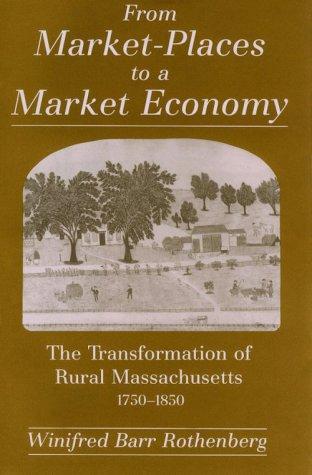
reconsidering rothenberg's from market places to a market economy, 20 years later: part I of a series

In this first installment of a series on the transition to capitalism in early America I am going to look back at one of the most influential books on the market revolution, Winifred Rothenberg's From Market-Places to a Market Economy, published 20 years ago. Rothenberg's work has since been read as a kind of "textbook" for understanding the liberal perspective on economic development and has (at least, I am told it has) been studied carefully by high-powered development economists at the World Bank and other organizations to help inform the crafting of development programs in the developing world, such as the Washington Consensus. Thus, given the importance of her work and its longstanding influence, I am going to reconsider her thesis in light of more recent work that has forced us to question some of the crucial premises of her hypothesis that the freeing up of (product and labor) markets laid the bedrock for industrial development in the early-19th century Northeast.

We note briefly that the premise of Rothenberg's thesis clearly depends on the widespread prevalence of local regulatory regimes of both product and labor markets in the 18th century, particularly the early 18th century (given that her observation of increasing market integration begins around 1750). To support that thesis, she draws primarily on quantitative data. Further qualitative support is found in the so-called "Whig" historiography of the American Revolution, of which the quintessential proponent is Gordon Wood's Radicalism of the American Revolution (1992).

For Wood, the American Revolution was radical in its assertion of a popular basis for politics. For Joyce Appleby, a scholar writing along similar lines, its importance for political economy was in its emphasis on liberalism as an economic philosophy -- stressing private property rights, enforceable contract, economic independence, and a laissez-faire theory of government policy. A corollary of this thesis is the rise of a free market mentalitie, as Rothenberg put it -- a rise in the value of free markets and trade for mutual gain among the newly democratic society. Rothenberg finds quantitative evidence of this assertion in the regional convergence of market prices for various agricultural goods as well as the rise of contract labor in the Northeast in the late-18th and early-19th centuries. Her analysis draws from account books, diaries, and prices taken from newspapers. A key aspect of her thesis is the rise of free contract labor and free labor more generally, as distinct from the coercive institutions of the early 18th century. The question to be answered there is, Did the American Revolution give rise to what we would eventually see as the "free labor" necessary to fuel the fire of the Industrialization of the North? Rothenberg answers with a resounding "Yes". Others have their reservations.

Writing from a different perspective, Morton Horwitz's 1977 Transformation in American Law had a chapter on contract law which suggested (but did not prove) a counter-hypothesis. Sifting through court records and treatises he finds that not only was labor subject to a set of legal controls in the early 19th century significantly curtailing its freedom to contract and its mobility, but that the law exhibited a clear class bias against the worker and in favor of entrepreneurship.  Taking issue with Horwitz's thesis in her own 25-year-later reconsideration (published on EH.net here) of Transformation she shows how many of the claims of class bias and worker unfreedom in Horwitz have not withstood more recent, closer examinations of the actual application (or more appropriately, lack thereof) of some of the seminal labor cases upon which Horwitz relies. (See Karsten's Head versus Heart for a good summary of right-to-quit law in the Northeast.)

Time to put race at the center of labor
history in the U.S. instead of  unfree white labor?
At this point, it seems that Rothenberg has the upper hand. Several other labor law histories centered on the Northeast accepted the basic claim that the American revolution was marked by a fundamental embracing of political equality, throwing off the institutional fetters of an unfree and coercive colonial America (including the legal system!). Indeed, if we are to question at least the labor market-side of her thesis, it behooves us to either find some more empirical evidence to support the Horwitzian argument about labor control in the early 19th century, or to reconsider the labor law history of the colonial era to see in what ways labor ever was unfree or coerced or regulated -- or we could do both.

In the next part of the series, we will see how recent historical research has questioned precisely the points mentioned in the previous paragraph, seriously calling into question whether labor developed along an essentially government-free trajectory in the early Republic.

Sunday, January 22, 2012

jeremy adelman on hirschman

Hirschman's "Rival Views" is a fascinating look at the
origins of moral and political critiques of capitalism
The following excerpt is from a "flavor essay", so to speak, of a forthcoming biography (by Jeremy Adelman) of one of the most interesting and important thinkers in institutional economics and political economy of the last century: Albert O. Hirschman. Hirschman is perhaps most popular for Exit, Voice, and Loyalty, which is a highly original discussion of how individuals behave in political and economic relationships. The following excerpts is from his early years at the Institute for Advanced Study at Princeton, in the 1970s. A very interesting story indeed:

Several weeks later, [Hirschman] walked before the podium in Dodds Auditorium at Princeton University to deliver the Janeway Lectures to large crowds of students and faculty on the theme of “Private and Public Happiness: Pursuits and Disappointments.” For Hirschman there was no basic choice between the two types of happiness; it was not “or” that conjoined public to private. If there was a choice, the point of the lectures was to argue that people were always choosing depending on their moods and inclinations, and it was this activity that Hirschman wanted to draw out. Hirschman’s Janeway Lectures addressed experiences and emotional responses to them—anger at educational institutions, self-incrimination for buying a large house and regretting it (“buyer’s remorse”), and the ever disappointing “driving experience,” which, far from yielding to the lyrical joy ride, more often plunged the BMW-driving pleasure-seeker into traffic jams and car payments. Pursuits of happiness wherever it was being dispensed left trails of disappointment.
In contrast to Olson’s “logic,” Hirschman presented a “dialectic” that unfolds within the self, a self comprised of a complex amalgam of drives. Hirschman’s pendular dialectic was the theme of Shifting Involvements: Private Interest and Public Action (Princeton University Press, 1982), in which he stuck his neck out to formulate an alternative to the gathering political and intellectual orthodoxy. “I have rarely felt so uncertain about a product of mine,” he told his daughter Katia. “Perhaps this is because, as I say in the preface, what I have written is less a work of social science, than the conceptual outline of one or several novels.” Indeed, the preface suggests that there is much more of Hirschman’s personal philosophy and life story stirred into the prose. It threatened to become a bildungsroman “with, as always in novels, a number of autobiographical touches mixed in here and there.”
If there were autobiographical touches, they were not so easy to see. Certainly, no reviewer picked them out, though many did pick on the book as a disappointing one. Compared to earlier books this one was a flop. Nowadays, it is often overshadowed. But one might read Shifting Involvements as a resistance against ideas of triumphalism of any one side and defeatism of any other. To both he insisted there was always more choice, there were always more possibilities, always hope.
More at the Institute for Advanced Study website here.

Wednesday, January 11, 2012

land of promise: an economic history of the united states, by michael lind


That's his newest book, due out in April, 2012. Lind asserts that contemporary debates over American economic policy have their roots in early 19th century debates over how internal improvements and manufactures should be promoted by the government. In one camp you had the more conservative view (advanced by people like Hamilton) that states should be heavily involved in the promotion of industry, and on the other, you had the "radical democratic" idea that the state should simply focus on providing a stable framework in which entrepreneurs could seek out private gain.

It might surprise some to find out that the radical libertarian philosophy did not experience a clear win in this debate. Consistently since its founding, the American state has been heavily involved in the promotion -- and even subsidization -- of American growth. Lind's work may be a way to revive these ideas again at a time in which the Keynesian notion of "Aggregate Demand Management" seems to define the limits of state interventionism -- in order to show how strikingly conservative this version of the "Keynesian" view actually is.

Here is the book's description from Amazon:
A sweeping and original work of economic history by Michael Lind, one of America’s leading intellectuals, Land of Promise recounts the epic story of America’s rise to become the world’s dominant economy. As ideological free marketers continue to square off against Keynesians in Congress and the press, economic policy remains at the center of political debate. Land of Promise offers a much-needed historical framework that sheds new light on our past—wisdom that offers lessons essential to our future. Building upon the strength and lucidity of his New York Times Notable Books The Next American Nation and Hamilton’s Republic, Lind delivers a necessary and revelatory examination of the roots of American prosperity—insight that will prove invaluable to anyone interested in exploring how we can move forward.

Monday, January 9, 2012

economic history link roundup, 1/9/12

A cartoon, yes, but still -- too simplistic?
Source http://www.spartacus.schoolnet.co.uk/USAchild.htm 
Remembering Katrina Honeymoon, late historian of women and children's labor in Industrial England. "'It remains an inconvenient truth,' she observed in 2010, 'that most working-class children (and therefore most children) in 18th- and 19th-century Britain did not enjoy the freedom to develop physically and mentally through play and education.'"

Healthcare? Technology? Infrastructure? The Japanese economy has far from stagnated over the last 20 years. "The Myth of Japan's Failure", an NYT opinion piece, fills us in on the details.

The "Lawyers, Guns, and Money" blog continue their excellent "this day in labor history" series with a look at the passing of NAFTA. They also recently won a blogging award for this series.

A great essay on Southern politics during the Cold War (from the "Lenin's Tomb" blog): "racial populism could become a recurring form of Southern politics thanks in part to the defeat and co-optation of turn-of-the-[20th ]century Southern multiracial populism."

Historicizing American Conservatism. "Alan Brinkley raises the question of how to think about the attraction of conservatism to people who are, as he puts it, perched precariously in the middle class. The recent rise of economic inequality, he suggests, may actually have led to the embrace of an antigovernment, antitax politics by middle-class and working-class people, who, facing stagnation of their incomes and living standards, have grown frustrated with a state that seems increasingly incapable of aiding them. The erosion of government...has not led to a call for more government, but rather to a sense of the impotence of the state and a deep pessimism about the possibilities of government activism, and a feeling of resentment about rising tax burdens that yield few tangible benefits (pp. 772-773)".

Saturday, January 7, 2012

law, labor, and capitalism syllabus

American shoemakers in the late-18th century.
Image source: http://griid.org/2011/03/01/march-1-creation
-of-the-first-union-with-a-closed-shop-agreement-in-the-u-s/ 
Here is a link to the "Law, Labor, and Capitalism in U.S. History" course which I plan to teach this semester.

I steered the course at various points more towards social and political history than what might be seen as standard for a legal studies course. I did this for two reasons.

  • The course is directed at juniors and I had trouble finding "digestible" material on labor law history for students who do not have a strong background in legal concepts. 
  • A study of social protests and political consciousness of labor can give a valuable perspective into the particular issues workers had with the law as well as how they sought to amend their position. Sometimes, legal history gets wrapped up in the evolution of rules and norms that have little to no impact on how social conflict is instigated or resolved through the law. My course represents an attempt to bring law and labor closer to each other.

Here is a good resource for constructing a legal history syllabus.

Tuesday, January 3, 2012

economic history job market candidates, 2011-2012

Part of a continuing series


Nicolas Ziebarth is getting his PhD from Northwestern and lists economic history as a primary field, which is interesting in and of itself -- usually economic historians try to sell themselves in a more actively-demanded area of specialization (labor economics or development, for example) and list economic history as a secondary field just to keep job prospects as open as possible.

He is interested in the role that resource misallocation plays in economic development. (Anyone out there in development familiar with this idea and can give a quick summary? Leave a comment!) His job market paper looks at its effects during the Great Depression. "Misallocation and Productivity During the Great Depression":
Abstract: Aggregate productivity fell by 18% between 1929 and 1933. Existing explanations for this decline have focused on unobserved shifts in factor inputs such as labor hoarding. I develop a new hypothesis that focuses on the role of resource misallocation between heterogeneous plants. Using a novel plant-level dataset, I study two industries: manufactured ice and cement. I decompose the overall change in industry-level productivity into effcient productivity shifts and misallocation as in Hsieh and Klenow (2009). Increases in misallocation between 1929 and 1931 can explain at a minimum 50% of the decline in productivity for cement, around 20% between 1931 and 1933, and 10 to 15% for 1933 to 1935. I estimate that increases in misallocation can explain 50% of the total decline in industry productivity for manufactured ice between 1929 and 1935. In order to explain these findings, I develop a model of financial frictions that relates misallocation to dispersion in working capital interest rates. If banks are unwilling to take on additional leverage to fund the most productive plants, credit becomes misallocated resulting in factor misallocation and lower aggregate productivity. My model therefore explains the empirically observed increase in misallocation through an increase in the marginal cost of leverage. I argue that these empirical and theoretical results provide another role for the non- monetary effects of the banking crisis during the Depression (Bernanke, 1983a): the collapse of aggregate productivity.
At the website I linked to he also has a paper which seems like more of a "big picture" project; the kind of economic history I find more interesting. He examines traditional models of "backwardness" of developing countries in "Are China and India Backward? Evidence from the 19th Century U.S. Census of Manufactures". The abstract:
Hsieh and Klenow (2009) argue that a large fraction of aggregate TFP differences between the U.S. and the developing countries of China and India can be explained by factor misallocation. Their interpretation is that this misallocation is due to institutions and policies in these developing countries that redirect resources from productive to unproductive firms. Using the U.S. Census of Manufactures from the late 19th century, I find that the level of dispersion in these modern, less developed countries is very similar to that in the 19th century U.S. What these countries share are not similar institutions but rather similar levels of economic development. The institutions of the U.S. at this time were much better than India or China in terms of protecting property rights and allocating resources to the most productive firms. This suggests that the Hsieh-Klenow measure of imperfections is not solely related to institutions but also the level of development. I apply their accounting procedure to the U.S. and find that between 4% and 7% of manufacturing TFP growth in the 20th century can be attributed to a more efficient intra-industry allocation of resources.
The fact that neither in terms of economic development nor institutions are the U.S. and China/India similar, and the fact that the international context is quite different, makes me question the comparison, but it's still an interesting question. And he tries to frame his work in the context of the latest theoretical work by Acemoglu (which goes to the source of how precisely institutions do impact growth, instead of just saying that they matter), though he is really building off of earlier work by Hsieah and Klenow and going in a somewhat different direction -- with implications for the institutional and economic perspective. 

Sunday, January 1, 2012

economic history link roundup

A new SSRN paper (by Roger Middleton) on the history of the British Historical Statistics Project, to commemorate its new online edition.

Lawyers, Guns and Money blog runs the latest installment in their "This Day in Labor History" series with a look at an early 20th century example of labor radicalism (they did a short history of the Knights of Labor a few days ago which was really good, too).

Remembering David Montgomery, renowned labor activist and U.S. labor historian.

A new book out of Florida University Press by Mary E. Frederickson entitled Looking South: Race, Gender, and the Transformation of Labor from Reconstruction to Globalization has some essays on the case of the U.S. after the Civil War that are definitely worth a look. Abstracts for all chapters included at the link.

Book forum sums up the latest discussions of American declinism; you can find my thoughts on this latest trend, with a comparison to how British decline was analyzed, here.

Happy New Year!

Thursday, December 29, 2011

economic historians on the job market, 2011-2012

The start of a continuing series.

A brief look at a few of the top mainstream departments (Harvard, Berkeley, Chicago...) does not reveal much in the way of budding economic historians (... I guess I shouldn't be surprised. Check back soon for more interesting candidates). However, one of Daron Acemoglu's students is working on some interesting projects related to political economic history: his name is Pablo Querubin. His job market paper is an econometric study of rent-seeking by U.S. politicians in the second half of the 19th century. Abstract and other papers (some of which are also on economic history) here.

The story according to mainstream economists is as follows. Politicians are assumed to be self-interested profit maximizers who seek to gain from the system by acting on their own interests -- interests which do not necessarily line up with the interests of their constituents. The amount of this rent-seeking behavior, furthermore, is strongly related to the accountability of the underlying political system (how fair the electoral system is and so on). In short, a democratic government such as what we have in the U.S. would probably have relatively fewer rent-seeking politicians than a despotic one would.

Now, if we consider the second half of the 19th century-United States, "democratic" usually isn't the first word that comes to mind. Nevertheless, the question is, what would we expect given the postbellum United States? Was there significant rent-seeking? How would you test for it? Querubin uses a methodology which allows him to test whether politicians who were elected by a close margin saw their incomes increase more than the losers of that close electiono over the course of the rest of their careers.

He finds that this was not the case for politicians who were elected in the 1870s, but that it was the case during the Civil War. He interprets this finding as suggesting that in periods when a democracy is in some kind of (political or economic or both) crisis, the space is opened for rent-seeking. Otherwise, a democracy like the U.S. operates pretty well at insulating against such behavior. This is further supported by evidence that a team headed by Acemoglu found recently supporting the idea that "financial firms connected to Timothy Geithner experience an abnormal return of 15% after his nomination as Treasury Secretary," which, since it took place during the financial crisis, qualifies in his story. Although it really doesn't, since Geithner is just one person and I'm not sure that the other contenders for the Treasury Secretary position are necessarily doing any better or worse than him (which would be the true test of the hypothesis).

But should we be surprised that in a capitalist democracy we find such results as Querubin's? Politicians already occupy certain class positions before they gain power, suggesting that if there is some disturbance to democracy, it occurs before anyone approaches the ballot box. If you're looking for a malfunctioning democracy, rent-seeking behavior is not necessarily the first place you would look. I suggest you look instead at the politics of the capitalist state itself: why didn't we see a full democratization of the south after the Civil War (indeed, the period under which Querubin finds no rent-seeking!), for example? The story that we usually find is that different groups of elites are fighting over public policy, often ignorant of the mass of workers, poor people, women and blacks below. It's not rent-seeking, but it is politics from a privileged position in the economic system.

In summary, Querubin's paper seems to present solid evidence against the public choice thesis that politicians are rent-seekers. And he seems to have some good things to say about our political system in the end -- we have a fair amount of checks in our electoral system to counterbalance any self-interested behavior by politicians. But it's only 2 cheers for democracy. Capitalist democracy may not produce rent-seeking politicians but it certainly does produce a situation in which not everyone has equal say in designing the "rules of the economic game".

Saturday, December 17, 2011

this just in: daron acemoglu down with #ows

In an interview on his top 5 recommended books on inequality:

"I’m definitely in that camp. I do believe in markets. I passionately believe in the importance of property rights and private property. I think they are absolute sine qua nons for prosperity. But I also believe that these things are very political and the politics shouldn’t be one-sided. Gore Vidal said, “The United States has only one party – the property party. It’s the party of big corporations, the party of money. It has two right wings; one is Democrat and the other is Republican.” If that is true, that’s a real threat to a free market and a fair society. For that reason I think Occupy Wall Street is very important. It’s a grassroots movement that tries to stand up to this tendency of our political system." 
Read the full interview here.