While it has been immensely fruitful to have scholars from political science, economics, and philosophy contribute to the debate on workplace democracy, one field has been surprisingly absent from that conversation: law. A quick check over at the Workplace Prof blog, for example, does not give any evidence of the debate being discussed. The Legal History Blog has also not engaged.
That's really too bad, because I believe that law can shed a useful perspective on some of the misconceptions held by those on both the right and the left in this debate.
First, on the right, Tabarrok chimes in with his discussion of worker quits. I actually already replied to him in this post -- but allow me to briefly flesh out the idea more.
The big event in early 1800s labor law was the conscious choice of applying Master-Servant law to all contract labor, not just contracts of servitude (i.e. indentured servants). Master-Servant law, as you can imagine, is more than simply "free contract"! It permitted judges to assume a substantial degree of authority into the labor contract as a contract which implies a degree of obedience of the worker to the capitalist. Such a law is, as Karen Orren states, essentially feudal. But Master-Servant law was a conscious choice of the judges at this time! Talking about this aspect of labor law is, I think, more crucial for understanding how workplace democracy has been prohibited over the history of capitalism.
On the left, Konczal replies to Tabarrok on quits, choosing to fight Tabarrok on his own turf rather than direct the workplace democracy debate in a more fruitful direction. Even Corey Robin commits a similar error by talking about pee breaks.
In short, the point is not about freedom to exit or not to exit, the point of workplace democracy is to control the conditions of one's work -- rights over how production is actually managed. Quitting or peeing may be part of that question, but on a more fundamental level we must recognize a legal system which implicitly assumes a degree of obedience and master authority which has existed and still exists to this day.
It would be interesting to see what legal scholars have to say about the space for expanding workplace democracy, or the history of workplace democracy over time. Yes we know a lot about unions, but we don't know as much about other forms of participation as sanctioned (or not) in the law.
Showing posts with label legal history. Show all posts
Showing posts with label legal history. Show all posts
Friday, July 27, 2012

Tuesday, July 3, 2012
tsk, tsk, alex tabarrok... tsk, tsk
In his laughable response to Crooked Timber bloggers' central claim that libertarians don't care an ounce for workplace democracy, Tabarrok makes the following comment:
Tabarrok is about 20 years behind in his research on 19th century American labor law. In a recent (2010) account, Christopher L. Tomlins convincingly demonstrates the relative lack of institutional controls on adult white male workers as far back as the 17th century. In what is a practical overturning of Steinfeld's thesis, Tomlins demonstrates the relative continuity of labor law for adult white males even through the Revolution and into the 19th century.
So the right to quit never was a key element of workers' concerns -- rather, as Tomlins suggests, it is the grafting of Master-Servant law onto employment relations in the late 18th century which represents the real significant legal change. And indeed, that set of laws was hierarchical and undemocratic.
Why is this important? Because it shows that whatever the right to exit may mean in social relations, it certainly is not the main issue and certainly does not comprise what we mean by "workplace democracy". Workplace democracy means the right to control conditions of labor, and that's something which Master-Servant law has quite clearly shown to not exist in American law.
If you think that the freedom to quit is without value bear in mind that under feudalism and into the early 19th century in the U.S. and a bit later in Britain employers and even potential employers could prevent workers from quitting and from moving. The freedom to quit was hard won. We should not disparage the liberation brought by a free market in labor.This is not in fact true. Freedom to quit, even in the early 19th century, was exercised across New England. See Jonathan Prude's Coming of Industrial Order for numerous accounts of "French Leave", or the practice of workers coming and going from the factories as they felt convenient.
Tabarrok is about 20 years behind in his research on 19th century American labor law. In a recent (2010) account, Christopher L. Tomlins convincingly demonstrates the relative lack of institutional controls on adult white male workers as far back as the 17th century. In what is a practical overturning of Steinfeld's thesis, Tomlins demonstrates the relative continuity of labor law for adult white males even through the Revolution and into the 19th century.
So the right to quit never was a key element of workers' concerns -- rather, as Tomlins suggests, it is the grafting of Master-Servant law onto employment relations in the late 18th century which represents the real significant legal change. And indeed, that set of laws was hierarchical and undemocratic.
Why is this important? Because it shows that whatever the right to exit may mean in social relations, it certainly is not the main issue and certainly does not comprise what we mean by "workplace democracy". Workplace democracy means the right to control conditions of labor, and that's something which Master-Servant law has quite clearly shown to not exist in American law.
Monday, May 7, 2012
fun legal quote of the day: sailors be damned!
Justice Waite rules in Matthews v. Terry, 10 Conn. 455 (1835):
There is no doubt but that, for just cause, a parent may reasonably correct his child, a master his apprentice, and a schoolmaster his pupil. Yet that power cannot be lawfully exercised, by a master over his hired servant, whether that servant is employed in husbandry, in manufacturing business, or in any other manner, except in the case of sailors.Sailors have a long and brutal history re: labor law. Richard B. Morris, for example, writes of the continued use of labor controls (imprisonment for contract breach, fines, etc.) on seamen into 20th century Maryland -- long after the use of indentured servitude (and of course slavery) had disappeared from the region.
Saturday, March 24, 2012
39 stripes
A slave code from Alabama (1852) reads:
Why 39? The number comes from the amount of lashes Paul received from the Jews, according to 2 Corinthians 11:24. Jewish executioners were not allowed to go above that amount of lashes according to the law of Moses (later codified into Roman law). 40 lashes was considered a death sentence.
#993. The patrol has power to punish slaves found under the circumstances recited in the preceding section, by stripes, not exceeding thirty-nine.(The "patrol" was the officer in charge of making rounds on the various plantations to catch slaves who were off their master's plantation without permission or who were simply loitering. Any white, male slaveowner below 60 years old were required to be available for patrol duty -- seems similar to jury duty today.)
Why 39? The number comes from the amount of lashes Paul received from the Jews, according to 2 Corinthians 11:24. Jewish executioners were not allowed to go above that amount of lashes according to the law of Moses (later codified into Roman law). 40 lashes was considered a death sentence.
Monday, March 5, 2012
legal history teaching materials
Someone who commented on my previous post asked for the reading list for the course I'm teaching on law, labor, and capitalism. I linked to it back in January -- you can find the post in which I linked to it here.
In addition to the reading list, I've uploaded two more items (both PDF). The first here is slides from a lecture I gave on the history of police in American history (inspired by Christopher Tomlins' research on the subject), titled "'F*ck tha Police'? Law, Institutional Change, and the American Revolution". The second here is a lecture on the relative autonomy thesis as applied in Morton Horwitz's brilliant Transformation in American Law, 1780-1860. The title of that one is much less interesting: "Relative Autonomy and Historical Materialism in Horwitz's Transformation in American Law".
Just a brief note: the field of legal history is ripe for economists' picking. It is indeed due time to revive the idea of a "law and economics for the left", or a "radical law and economics", or maybe simply, "heterodox law and economics", something in the spirit of the early 20th century Commons-esque old institutionalism, but updated with a more interdisciplinary and stronger theoretical outlook. I humbly consider my dissertation as one step in that direction -- we'll see where that goes.
More on these issues when I get around to getting them out of my head and putting them down somewhere.
In addition to the reading list, I've uploaded two more items (both PDF). The first here is slides from a lecture I gave on the history of police in American history (inspired by Christopher Tomlins' research on the subject), titled "'F*ck tha Police'? Law, Institutional Change, and the American Revolution". The second here is a lecture on the relative autonomy thesis as applied in Morton Horwitz's brilliant Transformation in American Law, 1780-1860. The title of that one is much less interesting: "Relative Autonomy and Historical Materialism in Horwitz's Transformation in American Law".
Just a brief note: the field of legal history is ripe for economists' picking. It is indeed due time to revive the idea of a "law and economics for the left", or a "radical law and economics", or maybe simply, "heterodox law and economics", something in the spirit of the early 20th century Commons-esque old institutionalism, but updated with a more interdisciplinary and stronger theoretical outlook. I humbly consider my dissertation as one step in that direction -- we'll see where that goes.
More on these issues when I get around to getting them out of my head and putting them down somewhere.
Sunday, February 19, 2012
where weber and kafka intersect: interesting new research
A (relatively) new article out of Law, Culture, and the Humanities (February 2011) by Douglas Litowitz titled "Max Weber and Franz Kafka: A Shared Vision of Modern Law" studies the impact of Weberian concepts of law using an interesting historical link between the two great thinkers. Here is a (gated) link to the article -- abstract below:
Recent scholarship suggests a line of influence from the sociologist Max Weber to the writer Franz Kafka, mediated through the lesser-known figure of Alfred Weber, who was Max’s younger brother and a law professor who served as one of Kafka’s law school examiners. This paper finds textual support for this claim of influence. Indeed, there is an uncanny similarity between Weber’s and Kafka’s writings on law, particularly in their diagnosis of a legitimation crisis at the heart of modern law, and in their suspicion that modern law cannot deliver on its promises.Weber and Kafka succeed at capturing the irrationalities, paradoxes, and disaffections of modern law, but in the final analysis their work suffers from a failure to appreciate law’s progressive and emancipatory potential.
Saturday, February 4, 2012
reconsidering rothenberg's from market places to a market economy, 20 years later: part I of a series
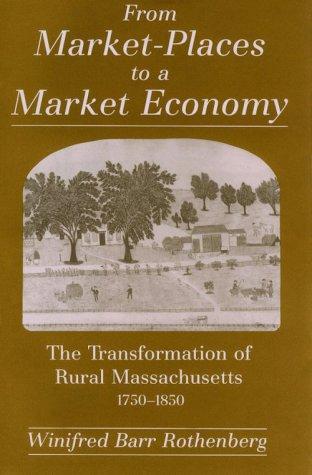
We note briefly that the premise of Rothenberg's thesis clearly depends on the widespread prevalence of local regulatory regimes of both product and labor markets in the 18th century, particularly the early 18th century (given that her observation of increasing market integration begins around 1750). To support that thesis, she draws primarily on quantitative data. Further qualitative support is found in the so-called "Whig" historiography of the American Revolution, of which the quintessential proponent is Gordon Wood's Radicalism of the American Revolution (1992).
For Wood, the American Revolution was radical in its assertion of a popular basis for politics. For Joyce Appleby, a scholar writing along similar lines, its importance for political economy was in its emphasis on liberalism as an economic philosophy -- stressing private property rights, enforceable contract, economic independence, and a laissez-faire theory of government policy. A corollary of this thesis is the rise of a free market mentalitie, as Rothenberg put it -- a rise in the value of free markets and trade for mutual gain among the newly democratic society. Rothenberg finds quantitative evidence of this assertion in the regional convergence of market prices for various agricultural goods as well as the rise of contract labor in the Northeast in the late-18th and early-19th centuries. Her analysis draws from account books, diaries, and prices taken from newspapers. A key aspect of her thesis is the rise of free contract labor and free labor more generally, as distinct from the coercive institutions of the early 18th century. The question to be answered there is, Did the American Revolution give rise to what we would eventually see as the "free labor" necessary to fuel the fire of the Industrialization of the North? Rothenberg answers with a resounding "Yes". Others have their reservations.
Writing from a different perspective, Morton Horwitz's 1977 Transformation in American Law had a chapter on contract law which suggested (but did not prove) a counter-hypothesis. Sifting through court records and treatises he finds that not only was labor subject to a set of legal controls in the early 19th century significantly curtailing its freedom to contract and its mobility, but that the law exhibited a clear class bias against the worker and in favor of entrepreneurship. Taking issue with Horwitz's thesis in her own 25-year-later reconsideration (published on EH.net here) of Transformation she shows how many of the claims of class bias and worker unfreedom in Horwitz have not withstood more recent, closer examinations of the actual application (or more appropriately, lack thereof) of some of the seminal labor cases upon which Horwitz relies. (See Karsten's Head versus Heart for a good summary of right-to-quit law in the Northeast.)
| Time to put race at the center of labor history in the U.S. instead of unfree white labor? |
In the next part of the series, we will see how recent historical research has questioned precisely the points mentioned in the previous paragraph, seriously calling into question whether labor developed along an essentially government-free trajectory in the early Republic.
Saturday, January 7, 2012
law, labor, and capitalism syllabus
 |
| American shoemakers in the late-18th century. Image source: http://griid.org/2011/03/01/march-1-creation -of-the-first-union-with-a-closed-shop-agreement-in-the-u-s/ |
I steered the course at various points more towards social and political history than what might be seen as standard for a legal studies course. I did this for two reasons.
- The course is directed at juniors and I had trouble finding "digestible" material on labor law history for students who do not have a strong background in legal concepts.
- A study of social protests and political consciousness of labor can give a valuable perspective into the particular issues workers had with the law as well as how they sought to amend their position. Sometimes, legal history gets wrapped up in the evolution of rules and norms that have little to no impact on how social conflict is instigated or resolved through the law. My course represents an attempt to bring law and labor closer to each other.
Here is a good resource for constructing a legal history syllabus.
Saturday, December 31, 2011
sovereignty and the american revolution: new research
I was surprised to see that the Legal History Blog didn't link to this symposium in the William and Mary Quarterly on "patriot royalism" during the American Revolution, since one of the cornerstones of the debate is the question of what it meant to be legally and ideologically separate from Britain. It kicks off with an intriguing paper by Eric Nelson, an up-and-coming political historian from the Harvard Kennedy School (he received his PhD from Cambridge University in 2002). Heavyweights such as Gordon Wood weigh in, with a hard criticism of the work. Unfortunately, ungated copies of the papers are not available.
But here's the abstract to Nelson's paper:
Of course, this debate must stay faithful the available historical evidence, which is not exactly on the side of Nelson (at least in terms of quantity of rhetoric in his favor) -- but do read through Nelson's paper if you have the opportunity, as he remains convincing throughout the debate. Another important point in the debate between Wood and Nelson worth considering is how to accurately trace the relative impact of certain speeches or treatises which were being circulated in the early 1770s. Very interesting stuff and highly recommended.
But here's the abstract to Nelson's paper:
'Patriot Royalism' makes the case that American patriots of the early 1770s became the last Atlantic defenders of the early Stuart monarchs. Their constitutional argument—that America was “outside of the realm” of Great Britain and therefore to be governed not by Parliament but by the royal prerogative—had famously been made by James I and Charles I in their acrimonious disputes with Parliament over colonial affairs in the 1620s. Most patriot writers were fully aware of the provenance of this new position and enthusiastically embraced its ideological implications. In the process they developed a radical, revisionist account of seventeenth-century English history. A proper reckoning with the story of patriot Royalism should allow us to appreciate the true drama of the republican turn in 1776, as well as to understand the persistent allure of prerogative powers in the formative period of American constitutionalism.In his response to Nelson, Wood downplays the idea of patriot royalism because he has argued, for many decades now, that the Revolution is characterized by a more radical ideological break from Britain. Nelson, in establishing a bit more nuance to the story, is drawing some fundamental interpretations in how we understand the nature of the American Revolution -- specifically trying to show that an undercurrent of conservative British principles of government runs through Revolutionary rhetoric. The study may in fact lead to a more radical questioning of the consensus view that the Revolution itself was so thoroughly libertarian, in place of a more nuanced view of the ideology of the elites who came to power in the years immediately following the Revolution (and leading up to 1789).
Of course, this debate must stay faithful the available historical evidence, which is not exactly on the side of Nelson (at least in terms of quantity of rhetoric in his favor) -- but do read through Nelson's paper if you have the opportunity, as he remains convincing throughout the debate. Another important point in the debate between Wood and Nelson worth considering is how to accurately trace the relative impact of certain speeches or treatises which were being circulated in the early 1770s. Very interesting stuff and highly recommended.
Monday, November 7, 2011
tomlins and uci law - changes in the air
Christopher Tomlins, who recently left his position at the American Bar Association to join the faculty at the newly created UC Irvine law school, is taking some important steps there toward making the study of law more interdisciplinary:
http://www.uci.edu/features/2011/11/feature_interdisciplinary_111107.php
A good quote from the article:
Tomlins, who is currently one of the most influential researchers of colonial and early American legal history, recently finished a mammoth book on law, labor and the shaping of civic identity in early America entitled Freedom Bound. It came out in 2010 via Cambridge Press and it is a masterpiece.
Even though Tomlins' work is still essentially legal history, where the evolutionary mechanisms behind rules takes center-stage, some of his latter works have dipped into the intersections of law and the literary mind (including research into the works of Walter Benjamin) and his overall approach to the law is basically Althusserian -- that is, studying the internal mechanisms of law as relatively autonomous from a materialist (feudal/capitalist) base. He is truly an excellent match for taking on such an interesting task at UCI.
http://www.uci.edu/features/2011/11/feature_interdisciplinary_111107.php
A good quote from the article:
[Tomlins] plans to have common colloquia, luncheon workshops, social functions and retreats so that students and faculty from different disciplines can swap perspectives.
“It will create a sense of interdisciplinary community and tie the law school into the rest of the campus,” Tomlins says. “Irvine is an especially appropriate place for such a program because there’s already an unusually large concentration of faculty outside the law school doing law-related work.”
The Program in Law & Graduate Studies, he says, is ideal for students interested in professional or academic careers involving law and legal institutions, policy analysis or applied research in law-related fields. These include criminal justice and criminology, urban planning and environmental issues, discrimination, human rights and intellectual property.
Tomlins, who is currently one of the most influential researchers of colonial and early American legal history, recently finished a mammoth book on law, labor and the shaping of civic identity in early America entitled Freedom Bound. It came out in 2010 via Cambridge Press and it is a masterpiece.
Even though Tomlins' work is still essentially legal history, where the evolutionary mechanisms behind rules takes center-stage, some of his latter works have dipped into the intersections of law and the literary mind (including research into the works of Walter Benjamin) and his overall approach to the law is basically Althusserian -- that is, studying the internal mechanisms of law as relatively autonomous from a materialist (feudal/capitalist) base. He is truly an excellent match for taking on such an interesting task at UCI.
Subscribe to:
Posts (Atom)